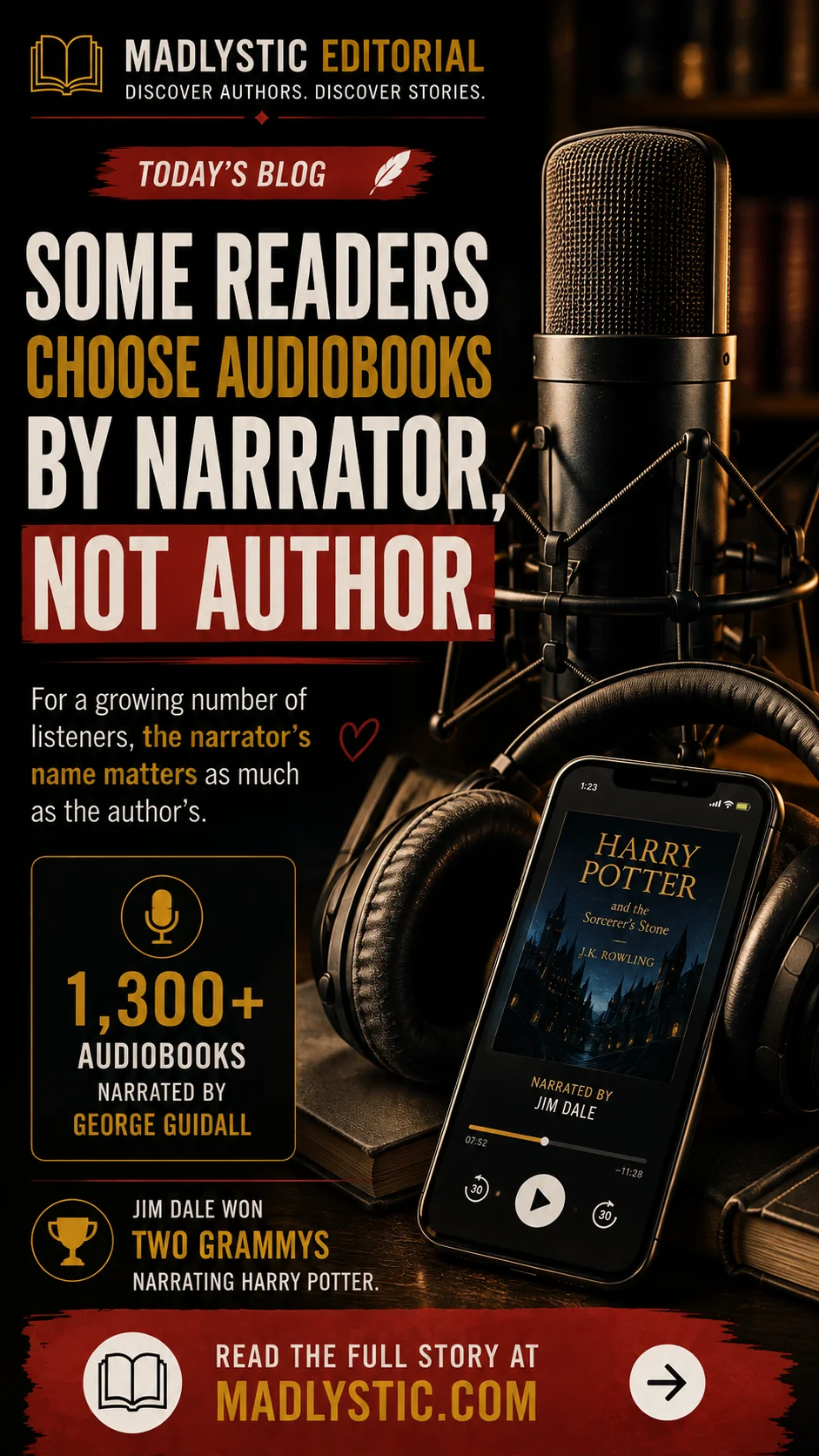
Some Readers Choose Audiobooks by Narrator, Not Author
George Guidall has narrated over 1,300 audiobooks. Jim Dale won two Grammys reading Harry Potter aloud. For a growing number of listeners, the narrator's name matters as much as the author's — here's the strange, real fandom behind the voice you never see.
Published August 8, 2026 · 12 views
8 min read
Quote of the Day
"It's perhaps no surprise that just like a reader has a preference for one author's voice over another, listeners will have a preference for one narrator over another." — a plain summary of a pattern the audiobook industry has quietly built an entire fandom around
Ask a dedicated audiobook listener how they pick their next listen, and a genuinely large number of them won't start with the author, or even the genre. They'll start with a name most readers of physical books have never once thought about: the narrator. It's a real, documented pattern with its own devoted fandoms, its own celebrity-tier names, and its own strange economics — and almost nobody outside the audiobook world has had it properly explained.
The scale some of these careers actually reach
A handful of narrators have built careers substantial enough to rival the authors whose words they're reading aloud. George Guidall has narrated over 1,300 audiobooks across more than two decades, becoming the voice behind many of the longest-running mystery and thriller series in the genre. Jim Dale, best known for narrating the entire Harry Potter series in the US, brought distinct voices to hundreds of individual characters across the franchise — a performance that earned him two Grammy Awards, eleven Audible Awards, and more than a dozen AudioFile Earphone Awards, and secured him a spot in Audible's Narrator Hall of Fame. Barbara Rosenblat has voiced over 400 books with a vocal range one fan described as sounding "almost as if you are listening to a multi-voice performance," despite being a single narrator working alone in a booth.
These aren't obscure industry-insider names, either — top-tier narrators can command tens of thousands of dollars per project and are frequently booked well in advance, a compensation level that reflects genuine, measurable listener demand for specific voices rather than interchangeable studio talent.
Why this happens: the performance genuinely changes the story
The mechanism behind narrator loyalty isn't really mysterious once you sit with it directly. A novel on the page leaves pacing, emphasis, and character voice largely up to the reader's own internal performance. An audiobook removes that control entirely and hands it to someone else — meaning the exact same text can land as a wildly different experience depending purely on delivery. One author candidly described this exact problem with her own book's audio edition: despite the author's "immaculate English," subtle misplaced emphasis in a non-native narration "changed the nuance of meaning... only slightly, but enough to distract from the storyline," repeatedly, across the listening experience.
This is precisely why industry data consistently shows listeners prioritizing narration quality above almost everything else. The Audio Publishers Association's own recurring consumer surveys have found a consistent pattern across both fiction and nonfiction listeners: audiobook consumers place a genuinely high priority on narration quality, and most actively prefer a professional voice actor over the book's own author reading their own words — a real, measured preference, not just anecdotal grumbling.
The genuinely strange consequence: authors often don't choose their own narrator
Here's a detail that surprises most casual listeners: for anyone published through a major publisher, the author typically has little to no say in who narrates their own book. Bestselling thriller author Brian Freeman confirmed this directly when a reader asked why two of his separate series shared the same narrator, making them hard to tell apart: "Authors don't actually choose the narrators. That's something the audio publishers do." One experienced voice in the self-publishing community laid out the fuller hierarchy plainly: self-published authors generally choose their own narrator, small-press authors often get some input, but authors at big publishing houses are frequently handed a narrator with no real input at all — publishers pursuing whichever voice, sometimes even a recognizable celebrity name, they believe will move the most units, "regardless of what's actually on the page."
Why some listeners actively avoid celebrity-narrated audiobooks
This creates a real, documented tension worth naming directly: publishers sometimes cast a celebrity narrator specifically for their existing platform and name recognition, independent of whether they're actually skilled at the craft of narration — acting, voice work, and audiobook narration are genuinely distinct skills that don't automatically transfer between each other. One longtime listener summarized the resulting skepticism plainly: celebrity-narrated audiobooks are frequently "pretty badly narrated," and experienced listeners have learned, sometimes the hard way, to check who's actually reading before committing to hours of listening time.
The unusual purchasing pattern this creates
The clearest evidence that narrator loyalty is genuinely real, not just a stated preference, shows up in a purchasing pattern unique to audiobooks: some listeners will buy or seek out an alternate edition of a book they've already read, specifically because a different narrator recorded it, treating the exact same text as effectively a different listening experience worth paying for again. This is a purchasing behavior with no real equivalent in print or ebook publishing — nobody rebuys the same paperback because a different printer typeset it — and it exists specifically because the performance itself, not just the underlying words, is what a genuinely devoted audiobook fan is actually paying for.
What this means for how audiobooks actually get discovered
This entire phenomenon complicates a common assumption about audiobook discovery: that it works the same way book discovery generally does — genre, author reputation, cover, description. For a meaningful segment of listeners, narrator name functions as an entirely separate, parallel discovery signal, sometimes a stronger one than the author's own name. A listener who loved Luke Daniels's narration of one urban fantasy series might specifically seek out anything else he's recorded, in a completely different genre, purely on the strength of his voice work — a pattern that mirrors, in a stranger and less-discussed way, exactly the kind of trusted-curator discovery this blog keeps returning to, just with the "curator" being a voice performer rather than an editor, critic, or bookseller.
Conclusion
The narrator sits in a genuinely unusual position in publishing: invisible on the cover, often uncredited in casual conversation about a book, and yet, for a real and sizable segment of readers, the single most important factor in whether an audiobook actually works. Understanding that helps explain a purchasing pattern that looks strange from outside the format entirely — buying the "same" book twice, seeking out a narrator's entire catalog regardless of genre, avoiding an otherwise great book because the wrong voice was cast to read it. It's not audiobook-listener eccentricity. It's a rational response to a simple fact print readers never have to think about: in audio, the performance and the story are inseparable, and a genuinely great narrator is doing far more creative work than most listeners, or most of the industry crediting them, ever fully acknowledge.
Share this article
Share this article with readers who'll want to read it.
You may also like
Why Reading Slumps Happen (And Why "Just Read More" Doesn't Fix Them)
July 23, 2026

What ARCs Actually Are (And Why 500,000 People Compete for Free Books)
August 3, 2026
Why So Many Book Series Never Get Finished
July 30, 2026

The Independent Bookstore Comeback: What It Really Says About Book Discovery
July 22, 2026