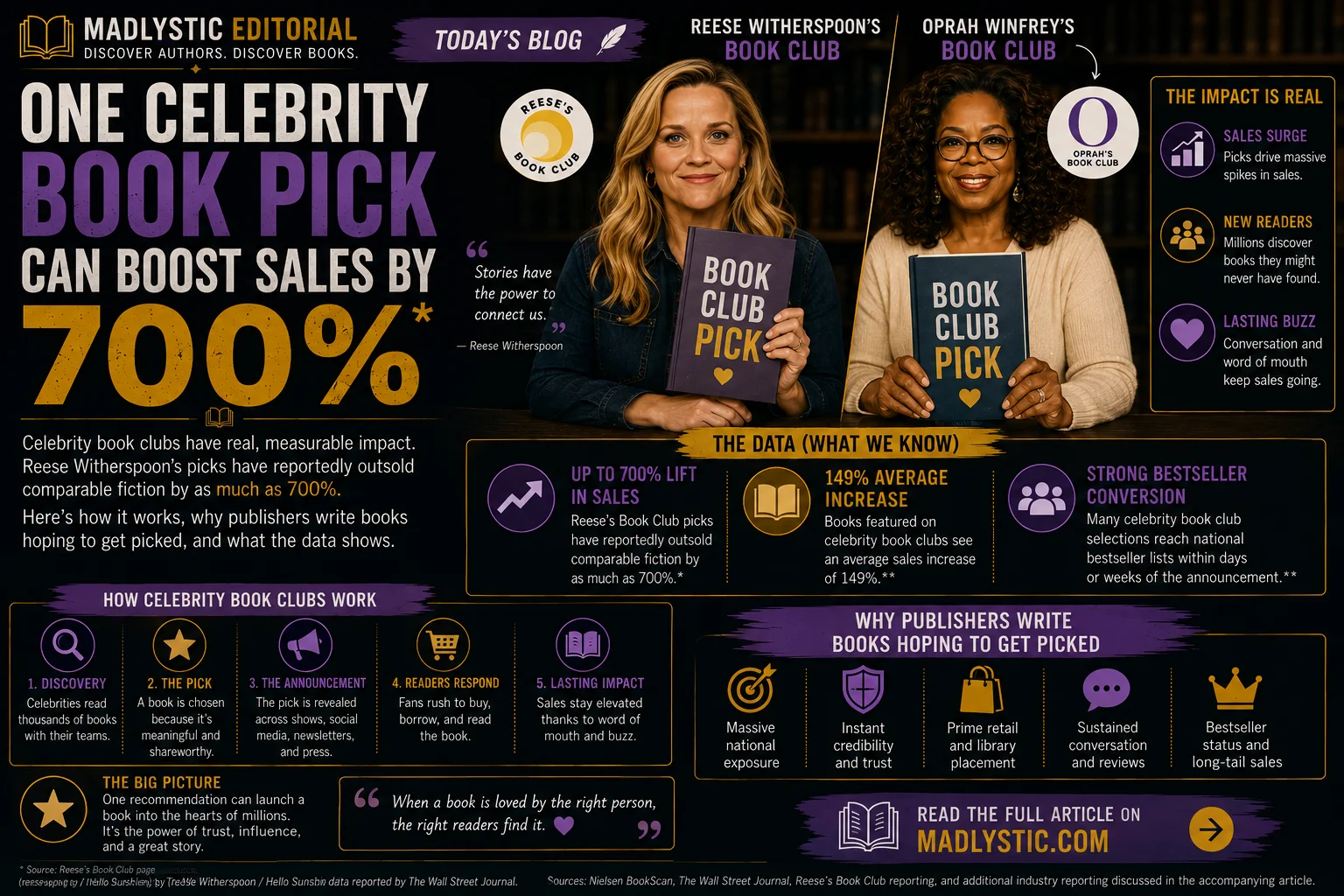
One Celebrity Book Pick Can Boost Sales by 700%
A single Reese Witherspoon pick reportedly outsells other fiction by 700%. Here's the real data behind celebrity book clubs — how much they actually move sales, why publishers now write books hoping to get picked, and one surprising exception to the pattern.
Published August 6, 2026
8 min read
Quote of the Day
"This is the equivalent of winning the lottery for these authors." — Kristen McLean, Executive Director of NPD BookScan, on what a Reese's Book Club selection means for a debut author
In September 2018, Delia Owens's Where the Crawdads Sing was a quietly performing debut novel, months into a modest release. Then Reese Witherspoon picked it for her book club. By the following spring, it had become one of the best-selling novels of the decade, eventually spawning a feature film. That trajectory isn't a fluke story — it's become a predictable, measurable pattern with real numbers behind it, and it's quietly reshaped how publishers think about acquiring and marketing books in the first place.
The actual numbers, and they're bigger than most readers assume
According to BookScan data reported by The Wall Street Journal, the first 41 titles selected for Reese's Book Club averaged 149% higher print sales than the top 1,000 fiction titles over the same period. Wikipedia's own summary of the club's track record puts it even more starkly: as of 2019, no Reese's Book Club pick had sold fewer than 10,000 copies, and selected novels have reportedly outsold comparable fiction by roughly 700%. One industry commentator, reflecting on that 700% figure directly, described it as reshaping not just individual book sales but entire publishing risk calculations, purchasing strategies, and even genre prioritization across the industry.
The track record extends well beyond any single standout hit. Of Jenna Bush Hager's first 68 "Read With Jenna" picks, 48 landed on the bestseller list. Of Witherspoon's first 97 picks, 68 did the same. And every single one of Oprah Winfrey's 27 picks that were published on the same day their selection was announced went on to become bestsellers — a perfect track record that one industry veteran, reflecting on a decade inside publishing, described as an almost unheard-of success rate for any marketing channel.
Why this works so much better than ordinary publisher marketing
Part of what makes these picks so effective isn't just visibility — it's the specific kind of trust attached to the endorsement. Reese's Book Club alone carries roughly 3 million followers on Instagram, a following that, as one analysis put it, rivals and in some cases actually surpasses traditional publisher marketing reach. Crucially, the promotion doesn't stop at the announcement: selected books get continued support from hardcover through paperback release, including giveaways and exclusive author content — sustained attention that an ordinary publisher marketing budget rarely maintains for this long after a single announcement moment.
There's also a deeper structural effect worth naming: several of Witherspoon's picks have gone on to become film and television adaptations through her production company, Hello Sunshine — including Little Fires Everywhere, Tiny Beautiful Things, and The Last Thing He Told Me. A book club selection, in other words, isn't just a marketing bump; for some titles, it's the literal first step in an adaptation pipeline that reshapes an author's entire career trajectory, not just one book's sales figures.
The genuinely surprising exception worth knowing about
Here's where the story gets more interesting than the simple "celebrity endorsement equals guaranteed sales" narrative most coverage settles for. Academic research cited on Oprah's Book Club's own Wikipedia page found something counterintuitive: in the twelve weeks following an Oprah endorsement, overall weekly adult fiction book sales across the broader market actually decreased by a statistically significant 2.5%. The likely explanation isn't that Oprah's picks failed to sell — they demonstrably did — but that her endorsement appears to have redirected reader attention and spending toward the selected title and away from other fiction purchases they might otherwise have made, rather than simply expanding the total pool of people buying books that month. It's less "more people are reading" and more "reading attention got concentrated onto one specific book."
Why the effect appears to be softening for younger readers
Worth noting honestly, since it complicates the picture rather than just reinforcing it: one publishing-industry veteran observed that while Reese's Book Club, Read With Jenna, and Oprah's Book Club still function as a genuine "one-way ticket out of potential obscurity" for a selected author, their overall brand equity has weakened somewhat, particularly among Gen Z readers — many of whom, as the same source put it, remember their mothers buying Oprah's picks before they could read themselves, but don't watch the morning television programming these clubs originally built their authority on. This doesn't undercut the sales data above, which remains real and significant — but it's a genuine signal that the specific cultural mechanism behind these clubs' influence is generational, tied to a media landscape (daytime and morning TV) that carries less weight with younger readers than it once did.
What this means for how books actually get discovered
This entire phenomenon is, at its core, a particularly concentrated, high-visibility version of the same mechanism covered elsewhere on this blog: trusted, individual curation outperforming algorithmic or purely commercial discovery. A celebrity book club pick works precisely because it functions as a specific, identifiable person publicly vouching for a book — not fundamentally different in mechanism from a staff recommendation at an independent bookstore, just operating at a vastly larger scale and with a built-in media apparatus behind it. The reason it moves sales so dramatically isn't magic; it's trust, concentrated and amplified to a degree few other discovery mechanisms in publishing can match.
Conclusion
The numbers behind celebrity book clubs are large enough that "winning the lottery" isn't really hyperbole — a 700% sales lift, a near-perfect bestseller conversion rate, and a pipeline that's produced multiple television and film adaptations represent a genuinely unusual concentration of influence in an industry where most books, even good ones, struggle for any visibility at all. But the mechanism underneath the celebrity glamour is simpler and more familiar than it looks: a specific, trusted person telling their audience "read this one" still works better than almost anything else publishing has, even in an era of algorithms, targeted ads, and infinite online content competing for the same reader's attention.
Share this article
Share this article with readers who'll want to read it.
You may also like
How the New York Times Bestseller List Really Works
November 9, 2026

The AI Detector That Cost a Novelist $2 Million Might Be Wrong 60% of the Time
August 7, 2026
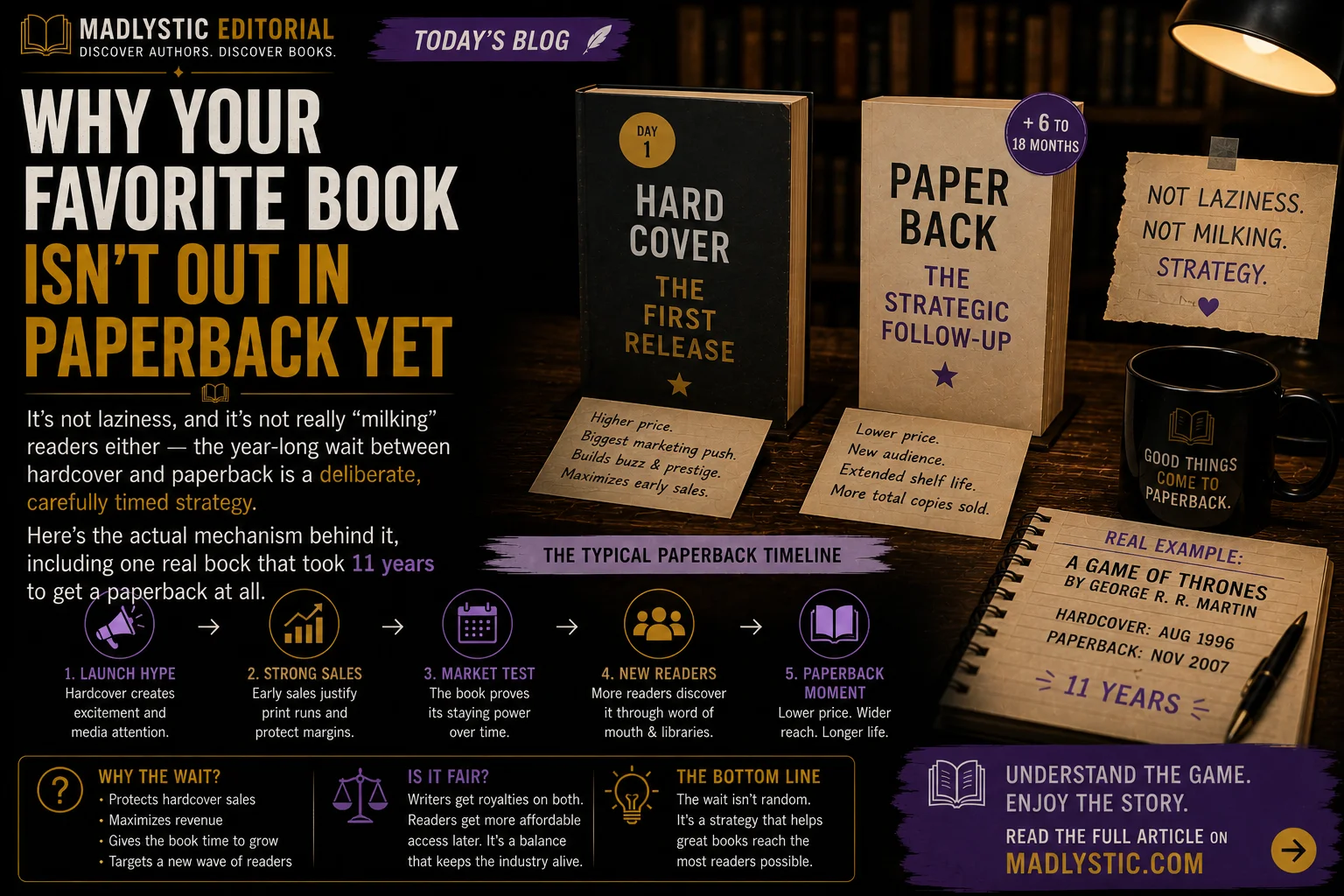
Why Your Favorite Book Isn't Out in Paperback Yet
August 5, 2026

75% of Celebrity Memoirs Aren't Written by the Celebrity
August 4, 2026