Why Your Favorite Book Isn't Out in Paperback Yet
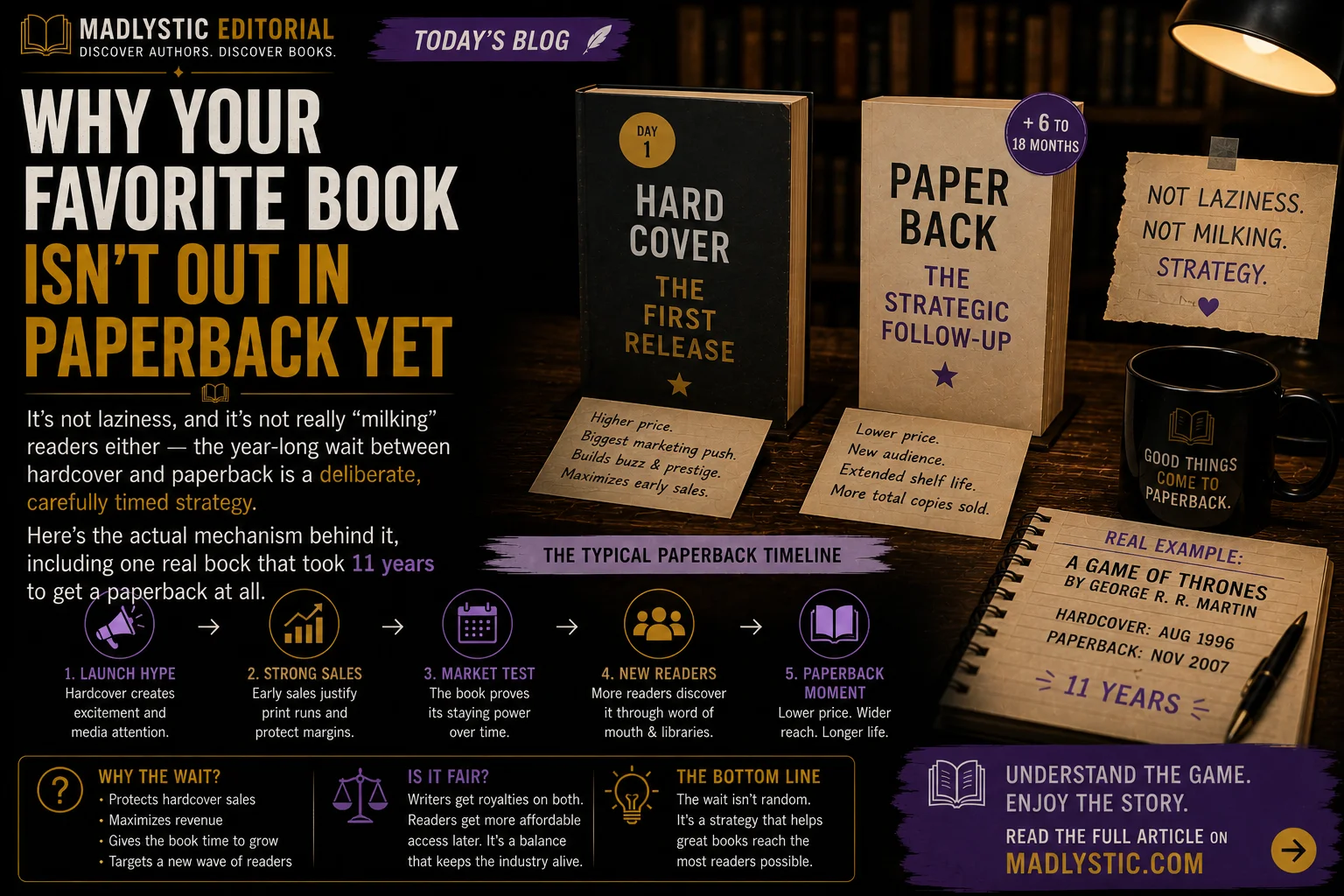
It's not laziness, and it's not really "milking" readers either — the year-long wait between hardcover and paperback is a deliberate, carefully timed strategy. Here's the actual mechanism behind it, including one real book that took 11 years to get a paperback at all.
Published August 5, 2026
8 min read
Quote of the Day
"There is also a level of prestige attached to a hardcover versus a paperback, as it shows a commitment by the publisher to the work." — publishing industry commentary on why hardcovers lead every release cycle
You find a book you're excited about, check for the paperback to save some money, and discover it simply doesn't exist yet — won't for close to a year. It feels almost arbitrary, like the publisher forgot a format existed. It isn't arbitrary at all. It's one of publishing's oldest, most deliberate pieces of release-timing strategy, and once the mechanism is laid out plainly, the wait stops feeling random and starts looking like a genuinely well-designed system — even if it's not always designed with the budget-conscious reader specifically in mind.
The standard timeline, and the two things that actually move it
The typical gap between a hardcover release and its paperback edition runs somewhere around a year, though the exact timing isn't fixed — it moves based on real, observable sales data rather than a rigid publishing-calendar rule. Shannon DeVito, former director of books at Barnes & Noble and now senior director of book strategy, explains the logic plainly: if a hardcover is selling exceptionally well, publishers will deliberately delay the paperback to keep that stronger revenue stream running as long as possible. If a hardcover is selling poorly, the opposite happens — publishers often push the paperback release earlier than usual, essentially cutting their losses and trying a cheaper format to find the audience the hardcover didn't.
Why hardcover gets to go first at all
The reasoning isn't just "more expensive book, more money" — though that's certainly part of it, since hardcovers carry a meaningfully higher price point and, per DeVito, authors typically earn a better royalty rate on hardcover sales specifically because the books cost more. There's also a genuine prestige and infrastructure advantage: hardcovers are more likely to be reviewed by major outlets, more likely to be considered for literary awards, and more likely to be ordered by libraries working with limited budgets who value the format's durability. A hardcover release, in other words, signals to the entire publishing ecosystem — critics, award committees, librarians, booksellers — that this book is being treated as a serious, significant release, not just inventory.
The part that sounds cynical but is really just logistics: protecting the bookstore's shelf life
Here's a detail rarely explained clearly: releasing a cheap paperback too soon after a hardcover actively hurts the bookstore, not just the publisher. A hardcover typically gets roughly six months of real shelf presence to sell before its momentum naturally tapers off. If a publisher released an identical, cheaper paperback edition during that same window, it would directly undercut the bookstore's own hardcover sales — leaving stores holding unsold hardcover inventory they'd then have to return to the publisher as unsellable stock, similar to the returns-and-destruction cycle covered elsewhere on this blog. Waiting until hardcover sales have genuinely leveled off before introducing the cheaper format protects everyone in the retail chain, not just the publisher's bottom line.
A second, deliberate marketing event, not just a delayed release
There's a genuinely smart strategic upside buried in the wait, too: releasing the paperback edition roughly a year later functions as an entirely separate publicity opportunity — a second, legitimate reason to generate fresh media coverage, bookstore displays, and reader attention right around the time a book's initial hardcover buzz would otherwise be fading into the background. It's not purely a delay tactic; it's a deliberately staggered two-act release strategy, designed to give a book two distinct moments of visibility instead of one.
The wildest real examples of how far this can stretch
Most books land somewhere in the standard six-months-to-a-year window, but the extremes are genuinely striking. Harry Potter and the Deathly Hallows — the final book in one of the best-selling series ever published — didn't get a paperback edition until two full years after its 2007 hardcover release, specifically because hardcover sales stayed strong enough that delaying made clear financial sense. Rainbow Rowell's Eleanor & Park takes this even further: released in hardcover in 2013, it didn't receive a dedicated paperback edition until 2024 — eleven years later. These aren't publishing mistakes or oversights; they're the same core mechanism, sales-driven timing, simply playing out at its most extreme.
Where ebooks complicate the whole picture
This entire system predates digital publishing, and ebooks have genuinely scrambled the clean hardcover-then-paperback logic. Some publishers have, at various points, deliberately delayed ebook releases specifically to protect early hardcover sales — a strategy directly borrowed from the film industry's theatrical-release windows before a movie hits home video. The reasoning drew real industry pushback at the time: unlike a DVD, an ebook doesn't cost the publisher meaningfully more to produce simultaneously, and delaying it risks losing a reader's purchase entirely to another book rather than simply deferring it to a later, cheaper format.
Why this isn't purely "milking" readers, even though it can feel that way
It's easy, especially as the reader waiting a year for a cheaper edition, to read this whole system as pure profit extraction — and there's real truth in that framing; publishers are, transparently, sequencing formats specifically to maximize total revenue per title. But it's worth holding two things as true at once: the strategy is genuinely revenue-driven, and it also serves real structural functions — protecting bookstore inventory, building award and review credibility, creating a second legitimate marketing moment — that would be harder to achieve if every format launched simultaneously and cannibalized each other's momentum from day one.
Conclusion
The wait for a paperback edition isn't a scheduling oversight or a random industry quirk — it's a carefully calibrated piece of release strategy, adjusted in real time based on how well a hardcover is actually performing, and shaped by a whole ecosystem of considerations — bookstore shelf life, award eligibility, library budgets, and a second shot at publicity — well beyond simply "keep the expensive version around longer." Knowing that doesn't make the wait shorter for a reader eager for the cheaper edition. But it does turn a genuinely frustrating delay into an explainable, even reasonably well-designed piece of publishing math, rather than an arbitrary inconvenience nobody bothered to justify.
Share this article
Share this article with readers who'll want to read it.
You may also like
How the New York Times Bestseller List Really Works
November 9, 2026

The AI Detector That Cost a Novelist $2 Million Might Be Wrong 60% of the Time
August 7, 2026

One Celebrity Book Pick Can Boost Sales by 700%
August 6, 2026

75% of Celebrity Memoirs Aren't Written by the Celebrity
August 4, 2026