Do Authors Get Paid When You Buy a Used Book?"
Millions of used books change hands every year, and almost none of that money reaches the person who wrote them. Here's exactly how used-book royalties actually work, why the system was built this way, and the one country quietly trying to fix it.
Published July 21, 2026
9 min read
Quote of the Day
"Buying a used book is no more piracy than buying a secondhand Christmas sweater at Goodwill." — Tiffany Reisz, bestselling author, responding to a debate over used bookstores in the publishing community.
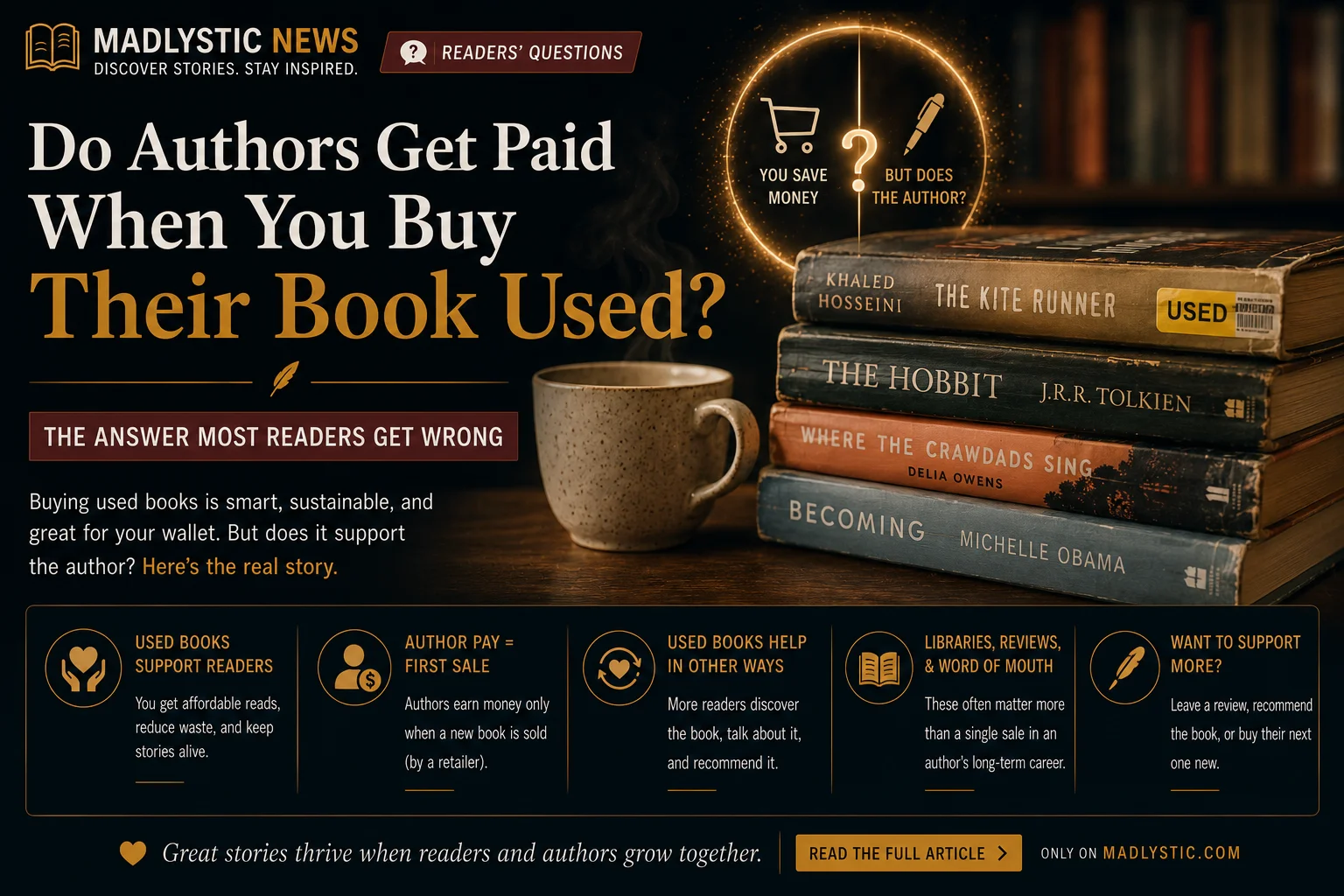
Here's a fact that surprises most readers the first time they hear it, stated as plainly as possible: when you buy a used book — from a thrift store, a used bookshop, Amazon's marketplace, or a friend — the author of that book receives exactly nothing. Not a cent, not a fraction of a cent, nothing. This isn't a loophole or an oversight. It's simply how the royalty system was built from the beginning, and understanding why reveals something genuinely important about how author income actually works — and where the real gaps in it are.
How royalty payment actually works, in plain terms
An author gets paid, in the traditional model, exactly once per copy — at the moment a retailer purchases that copy from the publisher to stock it for the first time. The math looks roughly like this: an author typically earns something in the range of 10-12% of the wholesale price a bookstore pays the publisher, not the retail price you see on the shelf. That single payment is the entirety of what the author will ever receive from that specific physical copy, no matter how many times it changes hands afterward.
This is, as one industry explainer puts it plainly, simply how royalties work for nearly every creative product — books, movies, music. A resale doesn't generate a new royalty because no new copy was manufactured or sold by the original rightsholder. The book that ends up in a used bookstore is the exact same physical unit the author was already paid for, once, at the point of its first sale.
Why this actually isn't the moral failure it sounds like
It's tempting to hear this and feel outraged on authors' behalf — and plenty of authors have, publicly and repeatedly, over the years. But the more interesting response comes from authors who've thought carefully about the actual mechanics and land somewhere more nuanced. Novelist Robin Epstein, whose latest novel she found being resold used within weeks of its release, still described actively understanding and even encouraging used bookstores — noting that she wants her books read as widely as possible, and recognizes that the price of a new book can be genuinely prohibitive for many readers.
There's a real economic argument buried in that reaction, not just generosity: a used sale still represents a reader encountering the book, potentially reviewing it, recommending it to friends, or becoming a genuine fan who buys the author's next book new. The royalty math on any single used copy is zero, but the discovery and word-of-mouth value isn't necessarily zero at all — it's just harder to measure and doesn't show up on a royalty statement.
Where this genuinely becomes a problem, rather than just an inconvenience
The more serious version of this issue isn't casual secondhand reading — it's when the used market moves aggressively against a book that's still actively trying to earn out its advance. Author Kristen Lamb has been notably blunt about this dynamic, arguing directly that readers who genuinely want to support a working writer should buy new, since authors are simply not paid for used copies at all, however the transaction is framed. For a midlist or debut author whose entire career trajectory depends on strong opening sales numbers, watching used copies flood the market within weeks of release — sometimes before the book has even been reviewed — is a genuinely different situation than an out-of-print backlist title finding a second life in a used bookstore years later.
The one place in the world actually trying to fix this
Here's the part almost no reader has ever heard about, because it's genuinely new and hasn't been widely reported outside the UK publishing trade press: in 2023, a UK scheme called AuthorSHARE launched specifically to close this gap. Created by William Pryor, founder of used bookseller Bookbarn International, in partnership with World of Books (the UK's largest used-book retailer), the Society of Authors, and the Authors' Licensing and Collecting Society, the scheme creates an actual royalty fund — starting at £200,000 in its first year, with the explicit intent to grow annually — paid out specifically for used book purchases made through participating retailers.
The scheme's own reasoning, in the words of ALCS chief executive Owen Atkinson, is refreshingly direct: writers deserve to be remunerated for every use of their work, whether that's library lending, photocopying, or resale, and this was previously the one major channel where that simply didn't happen at all. It's a genuinely novel piece of publishing-industry infrastructure — not a tip jar or a symbolic gesture, but an actual structured royalty mechanism built specifically to solve a problem the industry had quietly accepted as unsolvable for as long as used bookstores have existed. It currently only covers direct purchases through the participating retailers' own websites rather than third-party marketplaces, and it hasn't yet been replicated at scale outside the UK — but it's a real, working proof of concept that this gap isn't actually unfixable, just never seriously attempted before.
What this means if you're trying to genuinely support an author
None of this is an argument against used bookstores, which remain a genuinely valuable part of how books circulate, how readers on tight budgets access more books, and how out-of-print titles stay alive at all. But if the specific goal is putting money in a particular author's pocket — especially an indie or early-career author who doesn't have a large existing backlist cushioning them — a new purchase, a library checkout (which, in many countries, does generate a small payment to the author through public lending right schemes), or simply leaving a genuine review are all mechanisms that actually route value back to the person who wrote the book. A used copy, however many hands it passes through, routes value to precisely one point in that chain: the very first sale.
Conclusion
The used book market isn't a scandal or a loophole being quietly exploited — it's a genuinely reasonable extension of how ownership and resale work for any physical object, applied to books the same way it applies to a couch or a secondhand sweater. But it's worth actually knowing the mechanics rather than assuming, the way most readers do, that some invisible royalty trickles through every sale regardless of who's doing the selling. It doesn't. For readers who want their favorite authors to keep being able to write, the honest takeaway isn't guilt about visiting a used bookstore — it's simply knowing which specific actions, new purchases, library holds, reviews, word of mouth, actually move the needle for the person who wrote the words, and treating those as the real currency of support they actually are.
Share this article
Share this article with readers who'll want to read it.