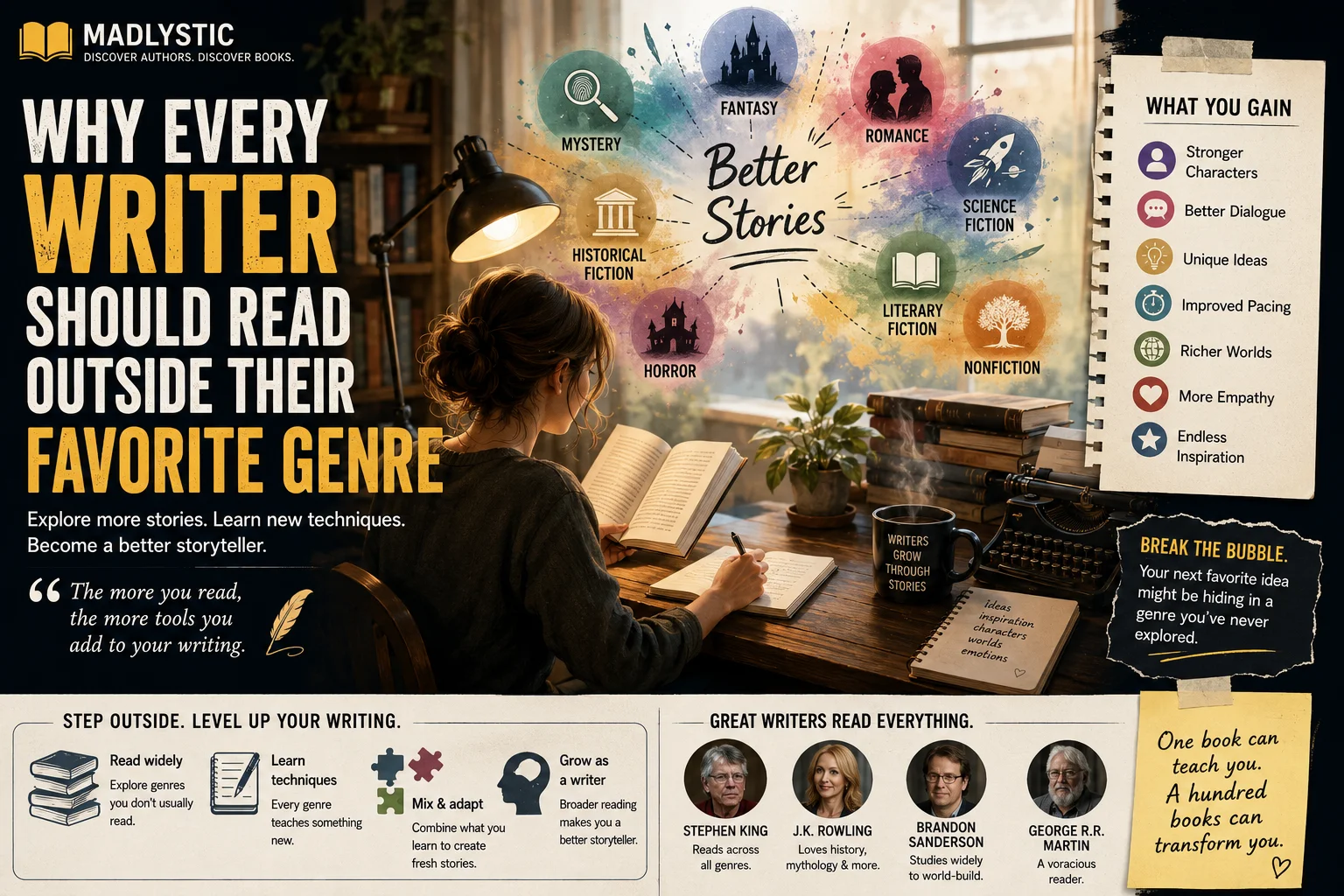
Why Every Writer Should Read Outside Their Favorite Genre
Why Every Writer Should Read Outside Their Favorite Genre Discover why reading outside your favorite genre can improve creativity, storytelling, dialogue, pacing, and character development while helping you become a stronger writer.
Published July 11, 2026
The Hidden Secret Behind Better Stories, Stronger Characters, and More Creative Writing
Published by Madlystic Editorial Team | July 8, 2026
Estimated Reading Time: 16–20 Minutes
Introduction
Every writer has a favorite genre.
Fantasy authors lose themselves in magical kingdoms. Mystery writers enjoy unraveling impossible crimes. Romance authors craft unforgettable love stories, while science fiction writers imagine futures beyond our wildest dreams.
There's nothing wrong with having a favorite genre.
In fact, passion is often what inspires people to start writing in the first place.
But here's something many successful authors understand:
If you only read one genre, your writing eventually begins to sound like everyone else's.
The world's greatest storytellers didn't become exceptional by reading only books similar to the ones they wanted to write. They explored history, psychology, biographies, philosophy, poetry, science, crime, romance, horror, literary fiction, and countless other subjects. Every book they read became another tool in their creative toolbox.
Reading outside your comfort zone isn't just about discovering new stories.
It's about becoming a better storyteller.
Whether you're writing your first novel or your twentieth, exploring unfamiliar genres can transform the way you think about characters, dialogue, pacing, world-building, emotion, and even your own creativity.
Let's discover why every writer should occasionally leave their favorite bookshelf behind.
Comfort Zones Create Comfortable Stories
Imagine a chef who only cooks Italian food.
They might become excellent at pasta and pizza.
But they'll never discover the flavors of Japanese sushi, Indian spices, Mexican street food, or French pastries.
Writing works the same way.
If every book you read follows the same structure, uses similar tropes, and tells familiar stories, your own writing may begin to repeat those patterns.
Readers notice repetition.
Fresh ideas often come from unexpected places.
Sometimes the best fantasy battle is inspired by a historical war.
Sometimes the best romance scene comes from reading literary fiction.
Sometimes the best villain is inspired by a biography.
Creativity grows through variety.
Every Genre Teaches Something Different
Every genre has its own strengths.
Reading broadly allows writers to learn techniques they might never encounter otherwise.
Fantasy
Fantasy teaches:
World-building
Mythology
Long-term storytelling
Complex magic systems
Mystery
Mystery develops:
Suspense
Foreshadowing
Clue placement
Pacing
Romance
Romance excels at:
Emotional connection
Dialogue
Character chemistry
Relationship arcs
Horror
Horror teaches:
Atmosphere
Tension
Psychological fear
Uncertainty
Historical Fiction
Historical novels demonstrate:
Research
Authentic settings
Cultural accuracy
Realistic detail
Science Fiction
Science fiction encourages:
Innovation
Ethical questions
Futuristic thinking
Big ideas
Literary Fiction
Literary fiction often emphasizes:
Beautiful prose
Symbolism
Character psychology
Emotional depth
Each genre is like attending a masterclass in a different storytelling skill.
Great Writers Are Curious Readers
One common trait among successful authors is curiosity.
They don't only read books that resemble their own work.
They read to learn.
They ask:
How does this author build tension?
Why does this dialogue feel so natural?
How did this chapter make me cry?
Why couldn't I stop reading?
Every book becomes an education.
Avoiding Predictable Stories
Readers love originality.
Ironically, originality often comes from combining ideas that normally don't appear together.
Imagine:
A detective story written with fantasy world-building.
A romance inspired by psychological thrillers.
Science fiction with literary prose.
Historical fiction told like a mystery.
Innovation happens where genres meet.
Stronger Characters Through Broader Reading
Characters don't exist inside genres.
People are complicated.
Reading biographies, memoirs, and literary fiction exposes writers to different personalities, cultures, struggles, and motivations.
The result?
More believable characters.
Instead of creating stereotypes, writers begin creating people.
Better Dialogue
Dialogue changes dramatically across genres.
A thriller often uses short, urgent conversations.
Romance focuses on emotional vulnerability.
Fantasy may include formal speech.
Literary fiction often embraces subtlety.
Reading different styles teaches flexibility.
Soon your dialogue feels more natural because you've experienced many voices.
Learning Different Pacing
Every genre moves differently.
Thrillers race forward.
Literary fiction slows down.
Mysteries carefully reveal clues.
Epic fantasy balances action with exploration.
Understanding different pacing helps writers control readers' emotions.
Expanding Your Vocabulary
Every genre introduces unique language.
Historical fiction teaches older expressions.
Science books introduce technical terms.
Poetry encourages precision.
Mystery sharpens descriptive detail.
Broader reading naturally expands your writing vocabulary without memorizing word lists.
Understanding Different Readers
Not everyone enjoys the same books.
Reading outside your comfort zone helps writers understand audiences beyond their own preferences.
This makes marketing easier.
It also improves empathy.
Breaking Creative Blocks
Writer's block often comes from consuming the same kind of content repeatedly.
Sometimes the solution isn't writing more.
It's reading something completely different.
A nonfiction book might inspire a fantasy novel.
A biography could spark an unforgettable villain.
Creativity thrives on unexpected connections.
Real Authors Read Everything
Many famous writers have spoken about reading widely.
They don't limit themselves to one shelf in the bookstore.
They explore:
History
Psychology
Science
Mythology
Poetry
Philosophy
Travel writing
Journalism
Memoirs
Classic literature
Children's books
Graphic novels
Every genre offers lessons.
The Danger of Writing Inside an Echo Chamber
Imagine reading only fantasy.
Eventually you'll unconsciously copy:
Character types.
Dialogue.
Magic systems.
Plots.
Tropes.
Readers who've consumed hundreds of fantasy novels notice repetition quickly.
Fresh voices stand out.
Fresh voices usually come from broad influences.
Reading Nonfiction Makes Fiction Better
Some writers avoid nonfiction.
That's a mistake.
Books about:
Psychology
Astronomy
Medicine
Economics
History
Architecture
Criminology
Forensics
Politics
Nature
can make fictional worlds richer and more believable.
Knowledge creates authenticity.
Reading Poetry Improves Prose
Poetry teaches:
Rhythm.
Imagery.
Word choice.
Emotion.
Economy.
Even novelists benefit from studying poetry.
Beautiful sentences often come from understanding rhythm rather than simply using complicated vocabulary.
Children's Books Teach Simplicity
Many bestselling authors recommend reading children's literature.
Why?
Because writing clearly is surprisingly difficult.
Children's books prove that simple language can still carry profound emotion.
Clarity always beats unnecessary complexity.
Graphic Novels Teach Visual Storytelling
Graphic novels and manga demonstrate:
Scene composition.
Visual pacing.
Action.
Expressions.
Transitions.
Novelists can learn a great deal from studying how visual stories communicate emotion.
Reading Classics Still Matters
Some writers avoid classics because they seem intimidating.
Yet classic literature continues to influence modern storytelling.
Understanding these foundations helps writers recognize where familiar ideas originated—and how to reinvent them.
Create Your Own Reading Challenge
Try reading one unfamiliar genre each month.
For example:
January — Biography
February — Horror
March — Historical Fiction
April — Science
May — Romance
June — Poetry
July — Mystery
August — Fantasy
September — Literary Fiction
October — Science Fiction
November — Memoir
December — Children's Literature
Within a year, your perspective on storytelling may change dramatically.
Practical Tips for Reading Outside Your Genre
If you're unsure where to begin:
Choose award-winning books from genres you've never explored.
Ask friends for recommendations.
Join a book club with varied selections.
Alternate between fiction and nonfiction.
Read short story collections before committing to long novels.
Keep notes on techniques you admire.
Ask yourself what each book taught you as a writer.
The goal isn't to become an expert in every genre—it's to become a more versatile storyteller.
Common Myths
"Reading other genres will confuse my writing."
In reality, it broadens your creative toolkit.
"I should only study books like the one I'm writing."
Studying your genre is important, but relying on it alone can limit originality.
"Nonfiction isn't useful for novelists."
Many unforgettable fictional worlds are grounded in real history, science, psychology, or culture.
"I don't have time."
Even one book outside your comfort zone every few months can introduce ideas that influence your writing for years.
Final Thoughts
Every book you read leaves something behind.
Sometimes it's a memorable character.
Sometimes it's a beautiful sentence.
Sometimes it's a new way of thinking about the world.
The most successful writers understand that inspiration rarely comes from reading the same type of story over and over. It comes from exploring unfamiliar ideas, different cultures, unexpected genres, and voices that challenge your assumptions.
Your favorite genre may shape the stories you want to tell.
But the genres you least expect may teach you how to tell them better.
So the next time you're standing in a bookstore or browsing an online library, resist the urge to head straight for your usual section.
Pick up something unexpected.
Your readers may never know where the inspiration came from.
But they'll notice the difference in every page you write.
Key Takeaways
📚 Every genre teaches unique storytelling skills.
🧠 Reading broadly strengthens creativity and originality.
🎭 Different genres improve dialogue, pacing, and character development.
🌍 Nonfiction and biographies add realism to fiction.
📖 Poetry improves prose and word choice.
🚀 Great writers remain lifelong learners and curious readers.
✨ Your next breakthrough idea may come from a genre you've never read before.
Short Description
Why should writers read outside their favorite genre? Discover how exploring different styles of books can improve creativity, storytelling, character development, and help you become a more versatile author.
Share this article
Share this article with readers who'll want to read it.