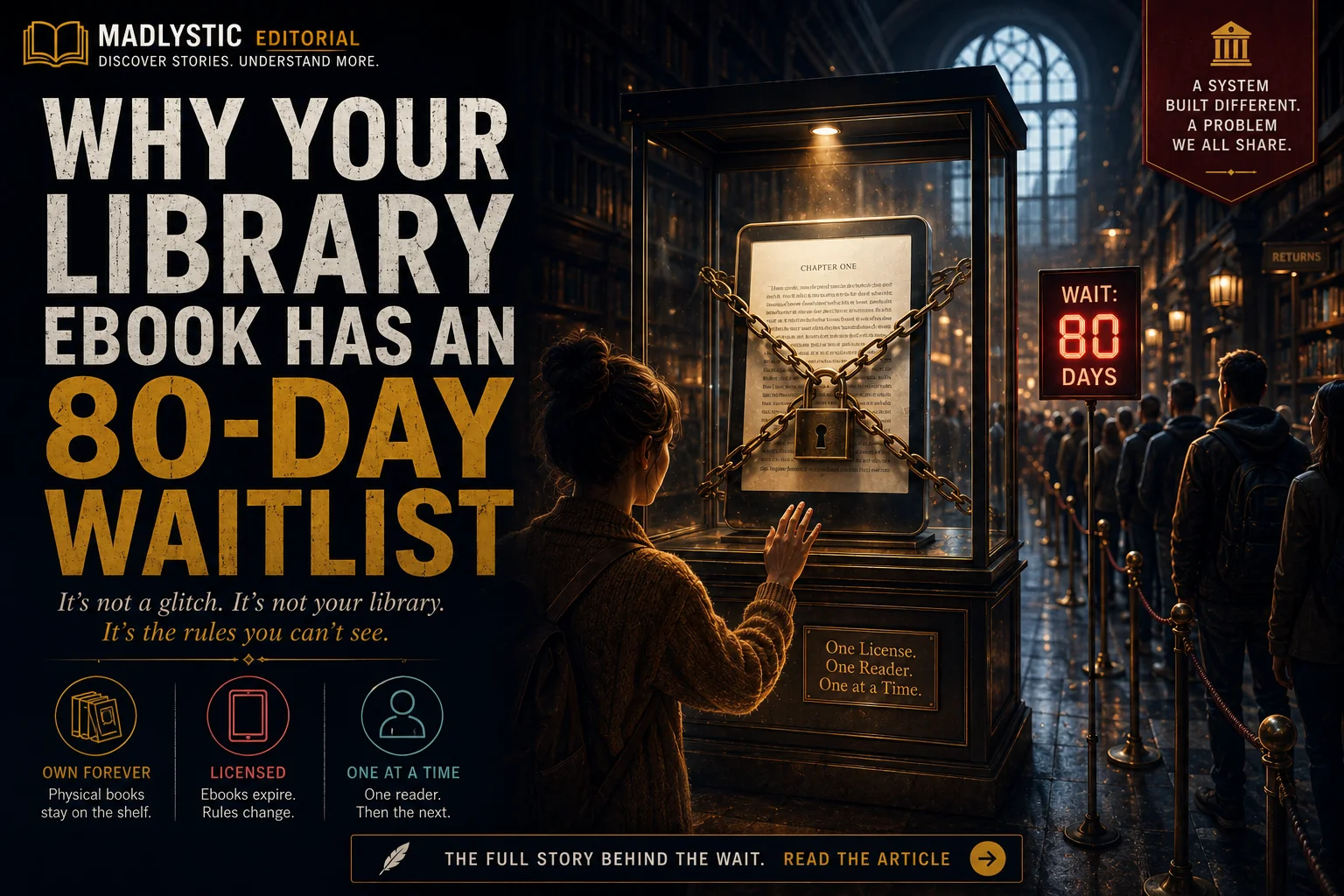
Why Your Library Ebook Has an 80-Day Waitlist
A library can buy a print book once and lend it forever. An ebook costs up to five times more, expires after two years, and still only serves one reader at a time. Here's the actual licensing system behind every ebook waitlist you've ever been stuck on.
Published July 24, 2026
9 min read
Quote of the Day
"A print book, as soon as the publisher puts it on the market, a library can get it... But digital books are just licenses, and if a publisher decides not to license to libraries, there is no recourse." — Alan Inouye, on the core legal difference between print and digital lending
Every reader who's used Libby or OverDrive has hit the same wall: a popular new release shows an 80-day wait, sometimes longer, while the exact same title sits available to buy instantly, for roughly the same price, on Kindle. It feels like a technical glitch or an underfunded local library failing you. It's neither. It's the direct, predictable result of a licensing system that treats an ebook fundamentally differently from a physical one — and once you see the actual numbers behind it, the wait stops looking arbitrary and starts looking like simple math.
The legal difference that explains everything else
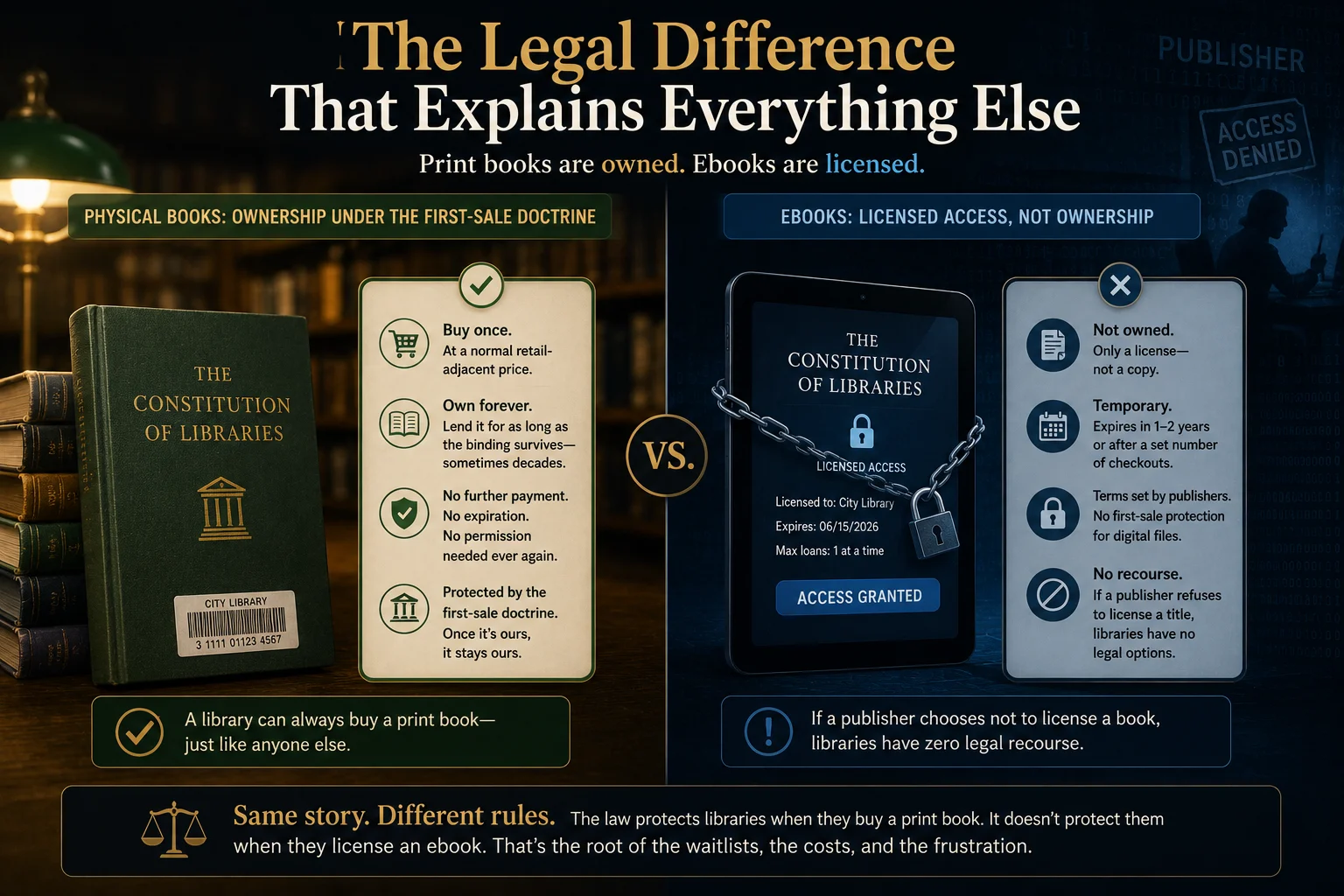
A library can buy a physical book once, at a normal retail-adjacent price, and lend it out for as long as the binding survives — sometimes decades — under a long-standing legal principle called the first-sale doctrine. Once a library owns a physical copy, that's it: no further payment, no expiration, no permission needed from the publisher ever again.
Ebooks don't work this way at all, and the difference isn't incidental — it's the entire root of the problem. A library doesn't own an ebook the way it owns a hardcover. It licenses temporary, restricted access to it, on terms the publisher sets unilaterally, with no equivalent first-sale protection applying to digital files. As one library advocate put it plainly, if a publisher simply decides not to license a book to libraries at all, libraries have no legal recourse whatsoever — a scenario that has zero equivalent in the print world, where a library can always just buy a copy at a bookstore like anyone else.
What libraries are actually paying, compared to what you'd pay
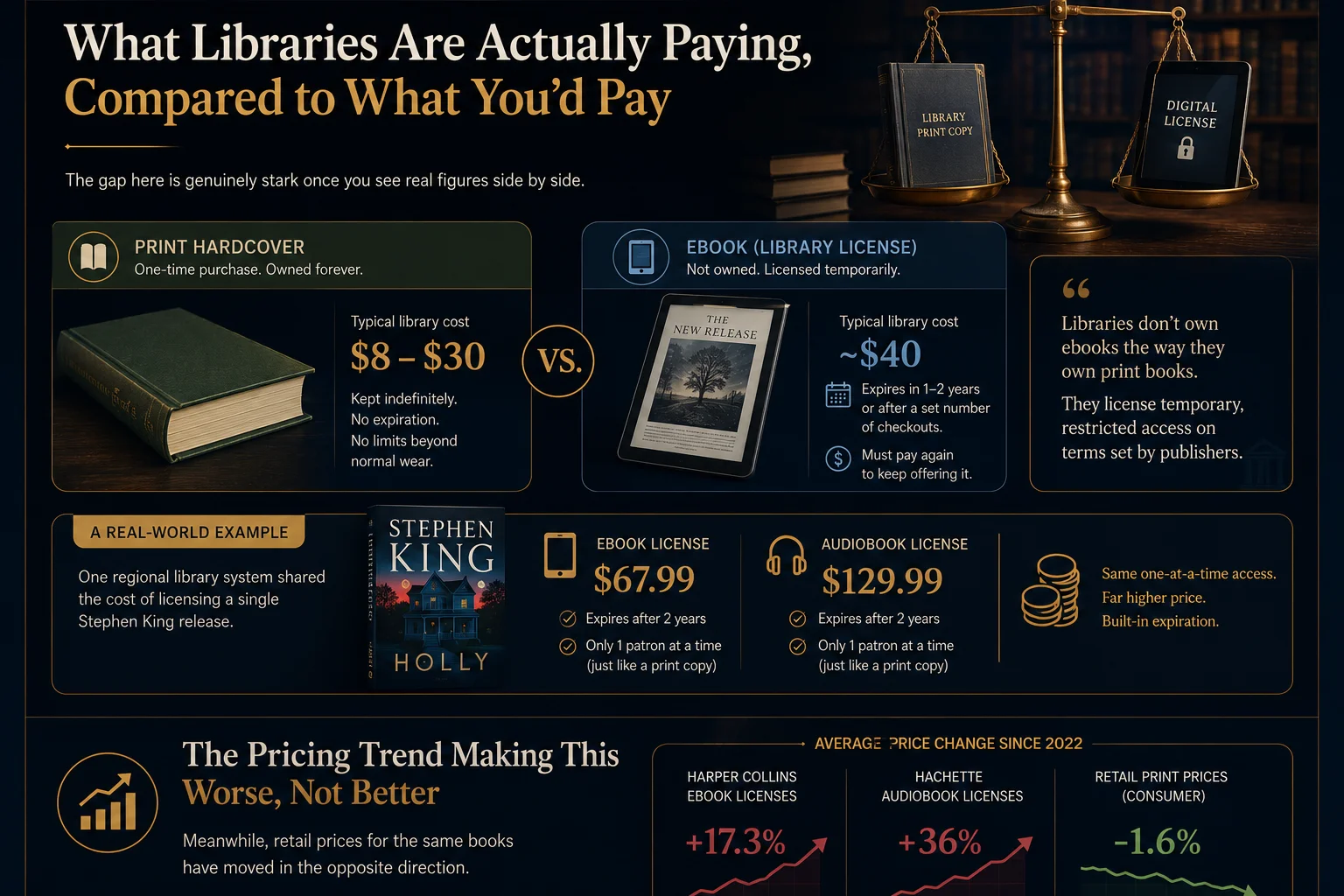
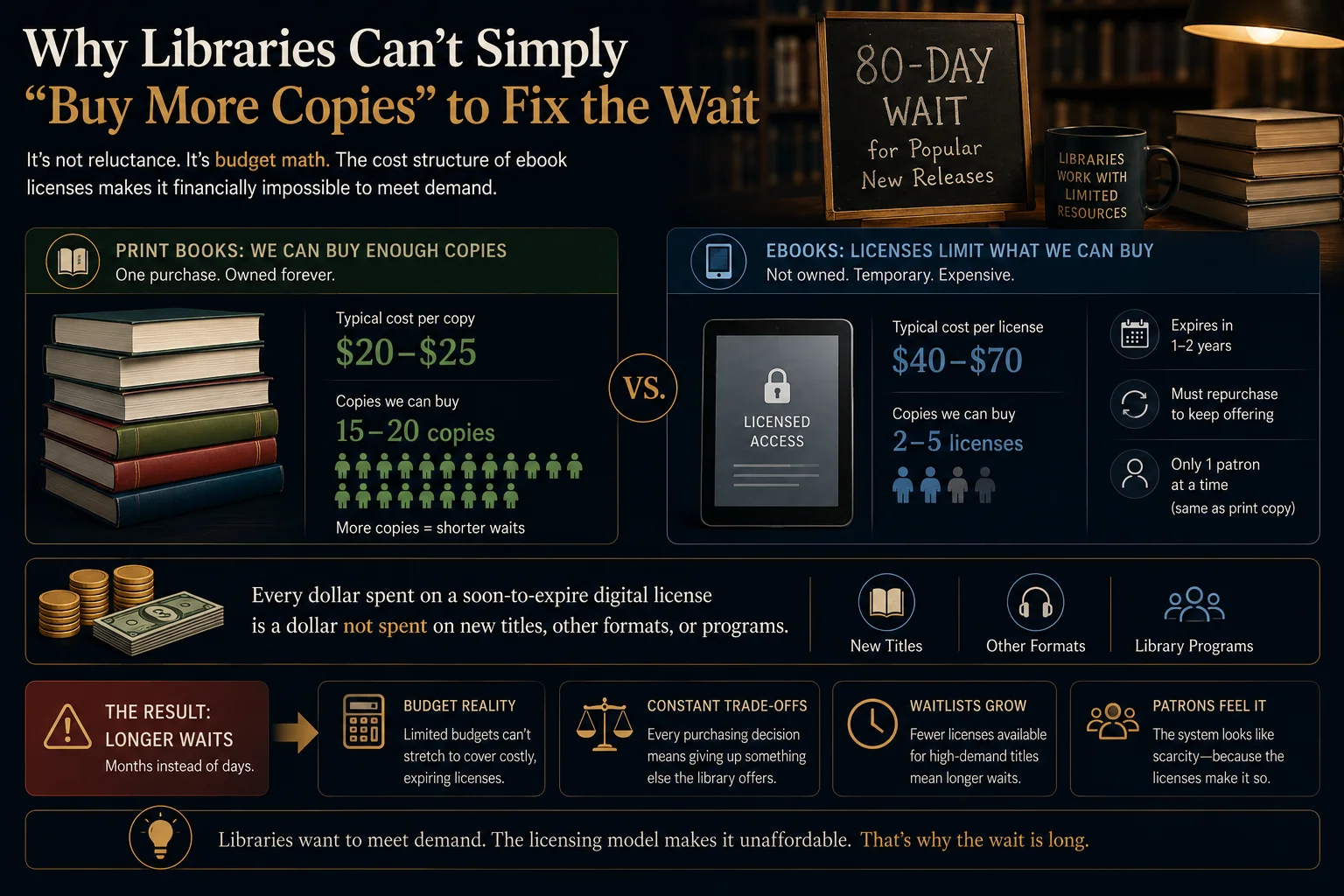
The gap here is genuinely stark once you see real figures side by side. A typical print hardcover might cost a library somewhere between $8 and $30, and the library keeps that copy indefinitely. The ebook version of the exact same title often costs roughly $40 — and unlike the print copy, that license typically expires after one to two years, or after a capped number of checkouts, at which point the library has to pay again just to keep offering it.
One regional library system laid out a concrete, current example: an ebook license for a single Stephen King release cost the library $67.99, expiring after two years. The audiobook version of that same title cost $129.99, also expiring after two years. And despite that steep price and built-in expiration, the license still only allows one single patron to borrow it at a time — functionally identical to the one-copy limitation of a physical book, just far more expensive and temporary.
The pricing trend making this worse, not better
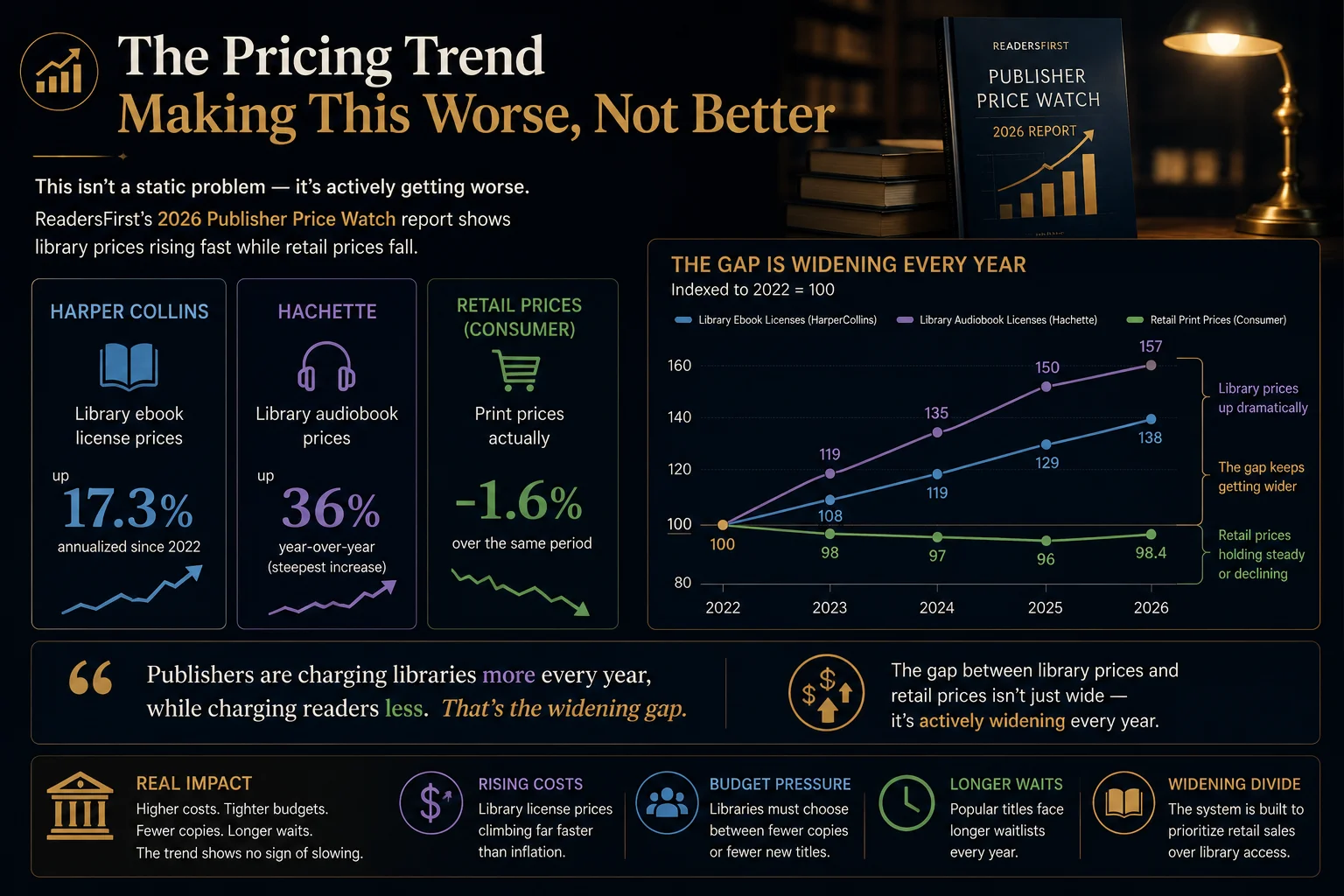
This isn't a static problem — it's actively getting worse, and the data behind that is tracked and published annually. According to the library advocacy group ReadersFirst's 2026 Publisher Price Watch report, HarperCollins has raised its library ebook license prices at an annualized rate of 17.3% since 2022, while Hachette's library audiobook prices jumped 36% year-over-year alone — the steepest increase tracked among the major publishers. Meanwhile, retail consumer prices for the same books have moved in the opposite direction, with print prices actually falling slightly over the same period. The gap between what a publisher charges a library and what it charges an individual reader isn't just wide — it's actively widening every year.
Why libraries can't simply "buy more copies" to fix the wait
The natural question is why a library facing an 80-day wait on a popular title doesn't simply purchase more licenses to meet demand. The honest answer is budget math: a library that might comfortably buy 15-20 physical copies of a hot new release at $20-25 each faces a completely different equation at $40-70 per ebook license, with a mandatory repurchase looming in one to two years regardless of how much it was actually used. Every dollar spent on a soon-to-expire digital license is a dollar not spent on new titles, other formats, or programs — a real, constant trade-off librarians navigate title by title, which is precisely why waitlists for popular new releases regularly stretch into months rather than days.
This has become a real, active political fight — not just an internal industry grumble
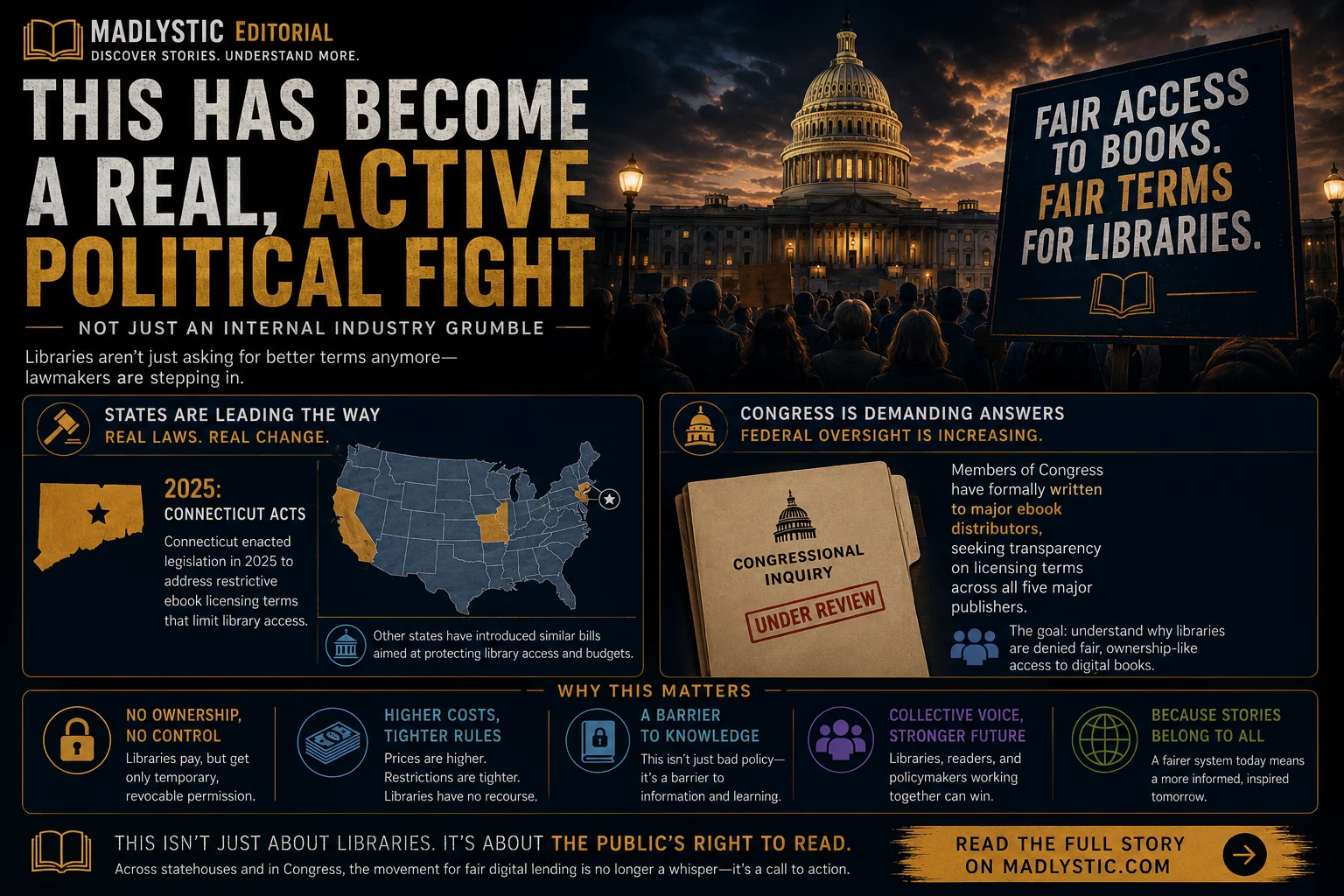
This isn't merely a quiet frustration confined to library budget meetings. It's escalated into actual legislative and regulatory action. Connecticut passed a law in 2025 specifically restricting the kinds of ebook licensing terms libraries can be forced to accept, and multiple other states have introduced similar bills. At the federal level, members of Congress have formally written to major ebook distributors demanding transparency on licensing terms across all five major publishers, citing the exact difficulty this article describes: publishers offering libraries no meaningful equivalent to outright ownership, only increasingly expensive, increasingly restricted permission to display a file temporarily.
What this means for you as a reader, practically
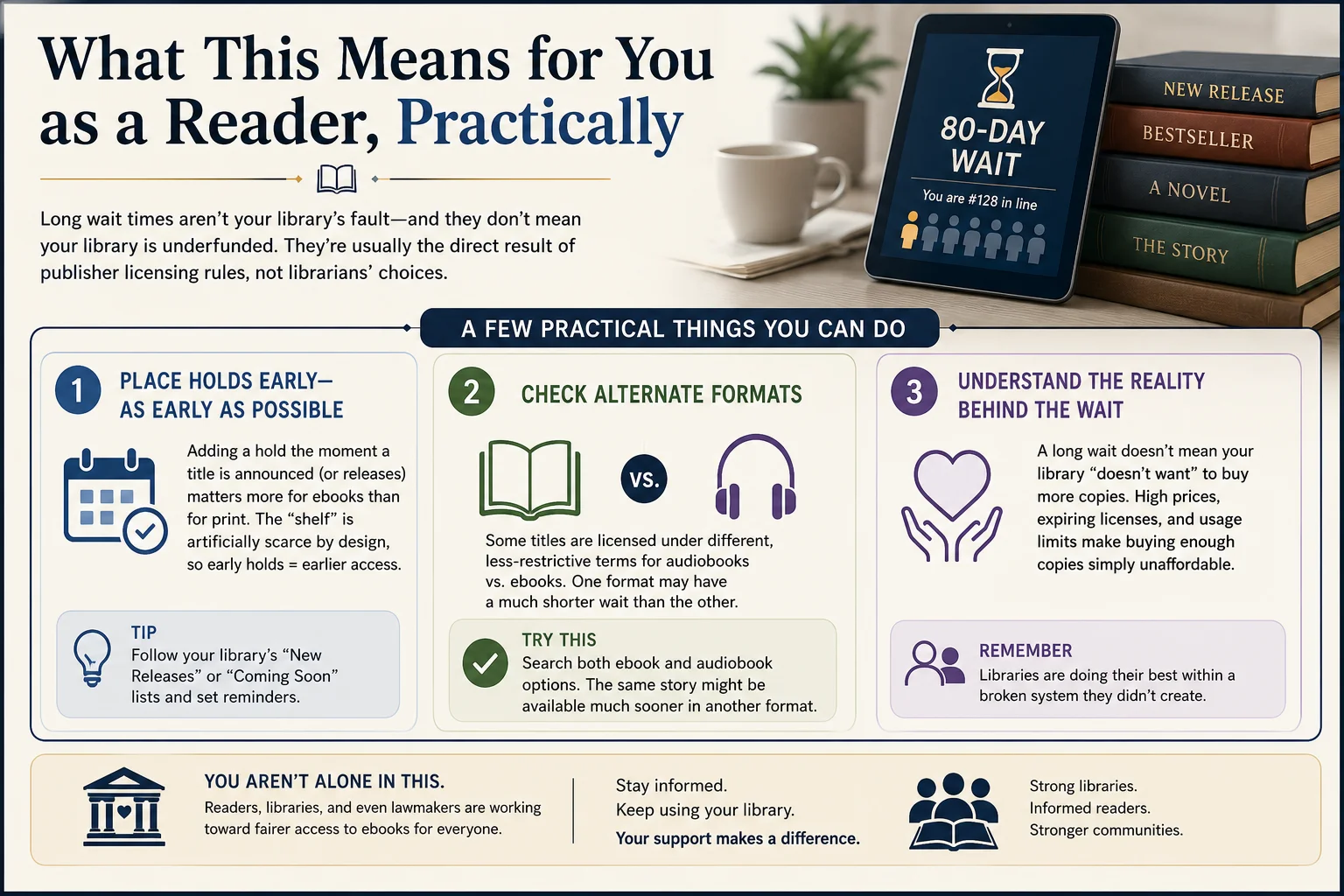
None of this means the wait is your library's fault, or a sign it's underfunded relative to peer institutions — it's usually a direct, rational response to a licensing structure designed by publishers, not librarians. A few practical things worth knowing: adding a hold as early as possible (even the moment a release date is announced) matters more for ebooks than it typically does for print, precisely because the "shelf" is artificially scarce by design rather than by physical printing limits. Checking whether your library offers alternate formats — some titles are licensed under different, less-restrictive terms for audiobook versus ebook versions, occasionally making one format's wait dramatically shorter than the other's for the exact same title. And understanding that a long wait genuinely isn't evidence the library "doesn't want" to buy more copies — it's usually the visible symptom of a pricing structure that makes buying enough copies to eliminate the wait entirely simply unaffordable at scale.
Conclusion
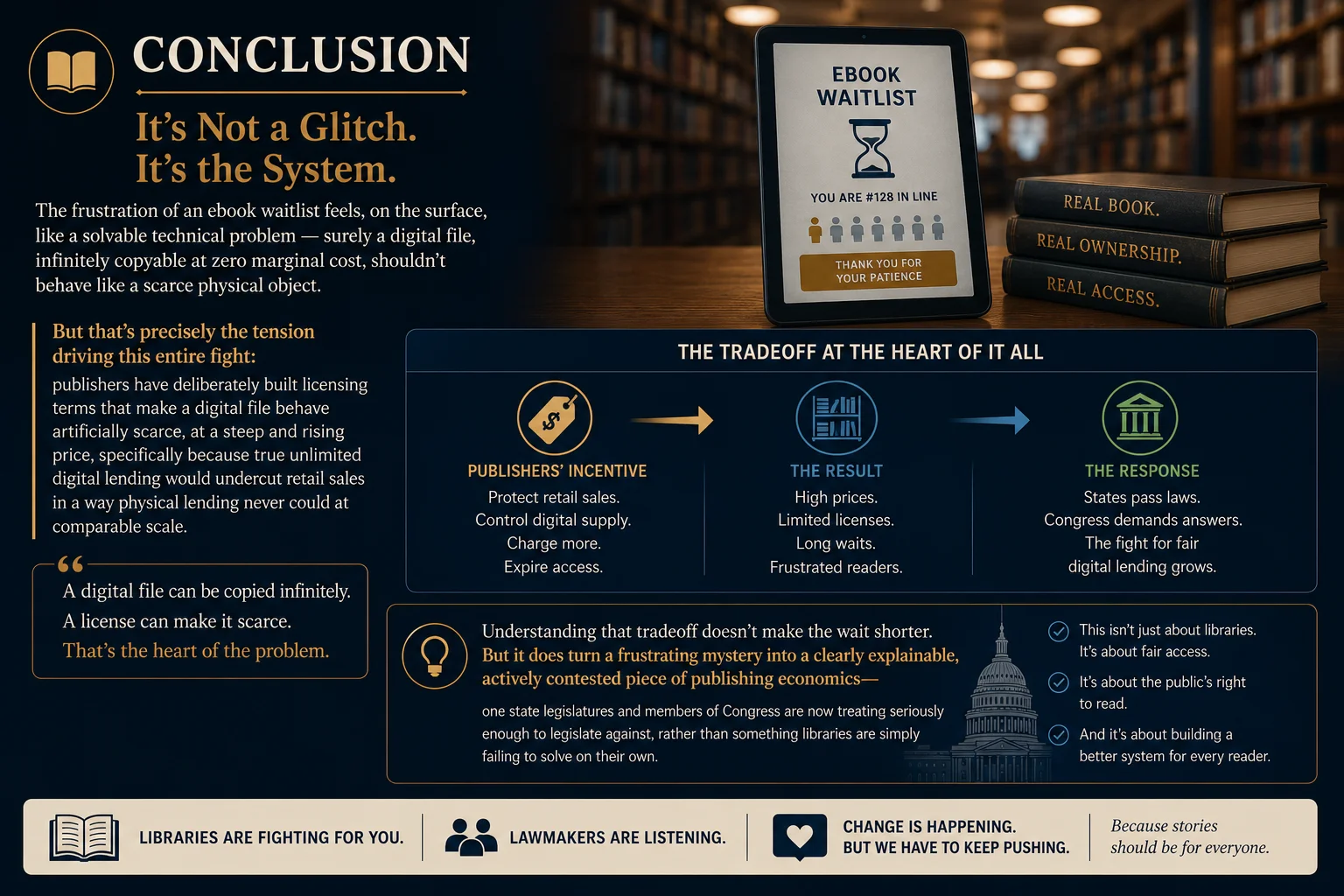
The frustration of an ebook waitlist feels, on the surface, like a solvable technical problem — surely a digital file, infinitely copyable at zero marginal cost, shouldn't behave like a scarce physical object. But that's precisely the tension driving this entire fight: publishers have deliberately built licensing terms that make a digital file behave artificially scarce, at a steep and rising price, specifically because true unlimited digital lending would undercut retail sales in a way physical lending never could at comparable scale. Understanding that tradeoff doesn't make the wait shorter. But it does turn a frustrating mystery into a clearly explainable, actively contested piece of publishing economics — one state legislatures and members of Congress are now treating seriously enough to legislate against, rather than something libraries are simply failing to solve on their own.
Share this article
Share this article with readers who'll want to read it.
You may also like
Libby Gives Readers More Control with New AI Content Filters
July 4, 2026
How the New York Times Bestseller List Really Works
November 9, 2026

The AI Detector That Cost a Novelist $2 Million Might Be Wrong 60% of the Time
August 7, 2026
One Celebrity Book Pick Can Boost Sales by 700%
August 6, 2026