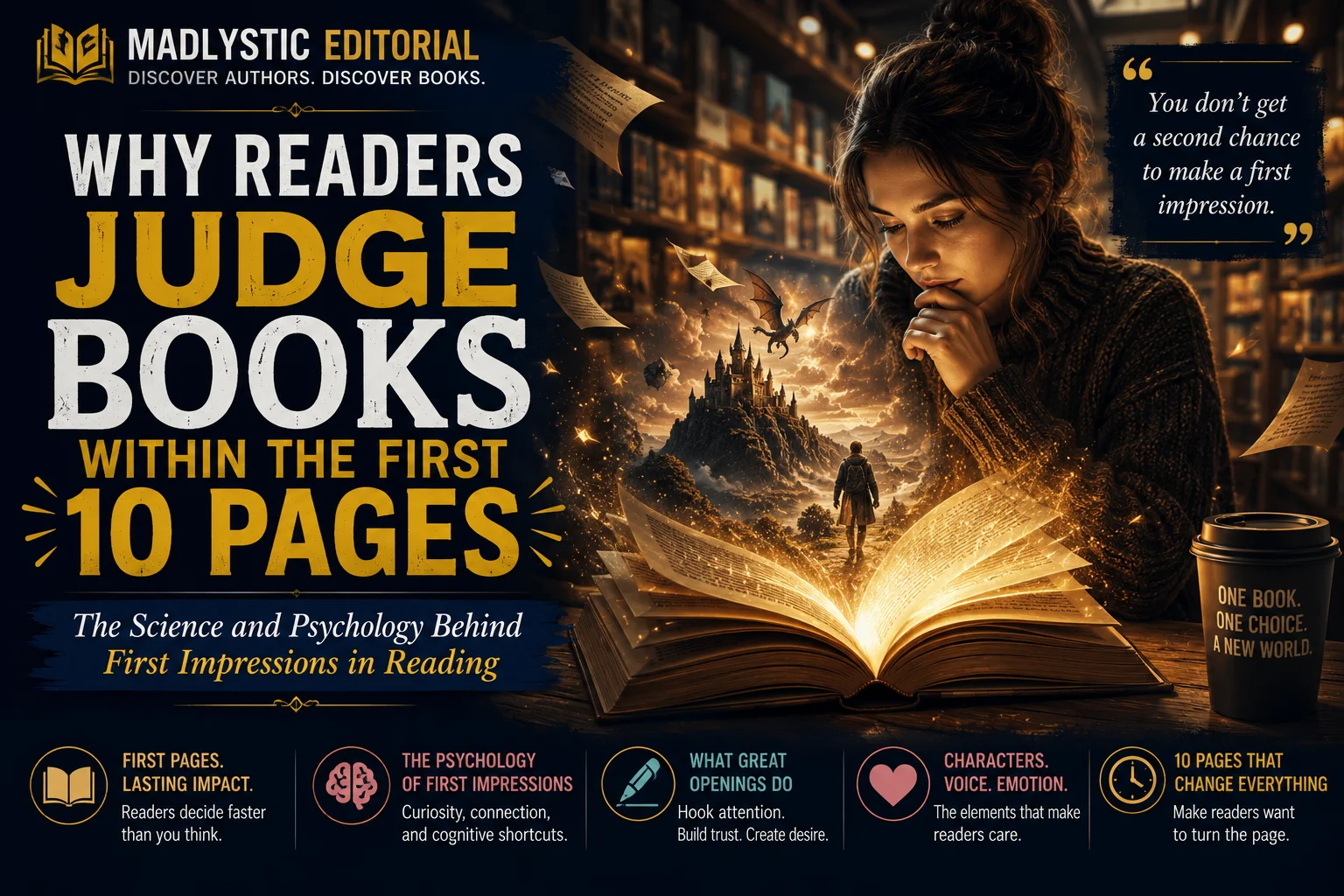
Why Readers Judge Books Within the First 10 Pages
Why Readers Judge Books Within the First 10 Pages | Madlystic Discover why readers often decide whether to finish a book within the first ten pages. Learn the psychology of first impressions, storytelling, pacing, and what makes an opening unforgettable.
Published July 16, 2026
The Science and Psychology Behind First Impressions in Reading
Published by Madlystic Editorial Team | July 16, 2026
Estimated Reading Time: 18–22 Minutes
Introduction
Imagine walking into a bookstore.
Thousands of books surround you.
You pick one from the shelf.
The cover catches your attention.
The blurb convinces you to give it a chance.
You open to the first page.
Maybe the first chapter.
Sometimes, before you've even reached page ten, you've already made a decision.
Continue reading…
Or put it back.
Most readers don't consciously realize they're making this judgment, but they are. In today's world, where readers have endless choices—from bookstores and libraries to eBooks and subscription services—the opening pages have become more important than ever.
Many readers decide whether a book deserves their time within the first few pages.
But why?
Is it impatience?
Short attention spans?
Or is there something deeper happening inside the human brain?
The answer lies in psychology, storytelling, and the way our minds naturally process first impressions.
Let's explore why those first ten pages can determine the fate of an entire book.
First Impressions Aren't Just for People
Psychologists have long studied the power of first impressions.
Humans make rapid judgments about people, places, and experiences.
Books are no different.
Within minutes of reading, the brain begins asking questions:
Is this interesting?
Can I trust this author?
Do I care about these characters?
Is this worth my time?
These questions often receive answers long before the first chapter ends.
Readers Have More Choices Than Ever
A century ago, readers often owned only a handful of books.
Today, readers can instantly access:
Millions of eBooks
Online bookstores
Public libraries
Audiobook services
Reading subscriptions
Independent publishers
With unlimited options comes greater selectivity.
If one book doesn't immediately capture attention, another is only a click away.
The Opening Makes a Promise
Every novel makes an unspoken promise.
It tells readers:
"This is the kind of story you're about to experience."
That promise includes:
Tone
Genre
Writing style
Emotional depth
Narrative voice
If the opening creates curiosity, readers naturally continue.
If it feels confusing or disconnected, they may stop before the story has a chance to unfold.
Curiosity Is More Powerful Than Information
Many new writers try to explain everything immediately.
Experienced writers often do the opposite.
They reveal just enough information to spark curiosity.
Readers don't need every answer.
They need compelling questions.
Who is this person?
Why is this happening?
What comes next?
Curiosity is what turns pages.
Readers Want Someone to Care About
A book doesn't always need immediate action.
But it almost always needs emotional connection.
Readers continue because they become invested in someone.
Whether it's:
A struggling detective
A lonely child
A determined scientist
A frightened soldier
A hopeful dreamer
Characters create emotional momentum.
Without that connection, even exciting events can feel distant.
Strong Voice Builds Trust
One of the quickest ways readers judge a book is through its narrative voice.
Voice is difficult to define but easy to recognize.
It's the personality behind the words.
A confident, engaging voice reassures readers that they're in capable hands.
If the writing feels uncertain or inconsistent, readers may lose confidence before the story truly begins.
Pacing Matters More Than Speed
Many people believe the first pages must be packed with explosions or dramatic action.
Not necessarily.
Fast pacing and engaging pacing are not the same.
A quiet conversation can be captivating if it raises questions.
A massive battle can feel dull if readers don't understand why it matters.
Good pacing creates momentum.
Not noise.
Readers Search for Clarity
Confusion isn't always mysterious.
Sometimes it's simply confusing.
Readers shouldn't struggle to understand:
Who the main character is.
Where the story takes place.
What is happening.
Why they should care.
Mystery encourages curiosity.
Confusion creates frustration.
Knowing the difference is essential.
The Power of the Curiosity Gap
Psychologists describe the curiosity gap as the space between what we know and what we want to know.
Stories thrive inside that gap.
The opening pages should leave readers wanting answers—not because information is missing unfairly, but because the mystery feels meaningful.
Emotional Investment Happens Quickly
Studies of decision-making suggest that people often form emotional opinions before logical ones.
Readers may not consciously think:
"I like this protagonist."
Instead, they simply continue reading.
Emotion usually arrives before analysis.
Every Genre Has Different Expectations
Readers approach genres differently.
A mystery reader expects intrigue.
A romance reader expects chemistry.
A fantasy reader expects world-building.
A thriller reader expects tension.
The first pages should reassure readers that they're getting the experience they came for.
The First Chapter Builds Trust
Think of the opening chapter as a conversation.
The author says:
"Come with me."
The reader decides whether to follow.
Every clear sentence, intriguing question, and believable character strengthens that trust.
Once trust exists, readers become far more willing to follow the author into unfamiliar territory.
Common Opening Mistakes
Many promising books lose readers because they begin with:
❌ Long information dumps.
❌ Too many characters introduced at once.
❌ Excessive backstory.
❌ Confusing timelines.
❌ Slow pacing without purpose.
❌ Dialogue with no context.
❌ Action before readers understand what's at stake.
The goal isn't perfection.
It's engagement.
What Great Openings Have in Common
Successful openings often share several qualities:
Clear voice
Immediate curiosity
Emotional connection
Focused storytelling
Strong atmosphere
Promised conflict
Memorable first lines
Readers don't need everything immediately.
They need enough to want more.
Advice for Writers
If you're writing a novel, ask yourself:
Would I keep reading this?
Does my opening create curiosity?
Have I introduced someone readers can care about?
Is my pacing engaging?
Have I avoided unnecessary exposition?
Does the first chapter reflect the rest of the book?
Remember, the goal of the first ten pages isn't to tell the entire story.
It's to make readers eager for page eleven.
Can Great Books Have Slow Beginnings?
Absolutely.
Some beloved classics take their time.
However, even slower openings usually offer something valuable:
Beautiful prose.
Interesting ideas.
Compelling atmosphere.
Strong voice.
Thought-provoking questions.
Readers are surprisingly patient when they're emotionally or intellectually engaged.
Final Thoughts
The first ten pages of a book are more than an introduction—they're an invitation.
They introduce readers to a new world, establish trust, and create the curiosity that keeps pages turning. In an era where readers have more choices than ever, those opening moments carry enormous weight.
A memorable beginning doesn't need nonstop action or dramatic twists. It needs purpose. It needs characters worth caring about, questions worth answering, and a voice that makes readers feel confident they're in capable hands.
For authors, the lesson is simple: don't try to tell readers everything at once.
Give them a reason to stay.
Because if page ten leaves them wanting page eleven, you've already accomplished something remarkable.
Key Takeaways
📖 Readers often decide whether to continue within the first few pages.
🧠 Strong first impressions shape the reading experience.
❓ Curiosity is more powerful than immediate answers.
❤️ Emotional connection keeps readers invested.
✍️ Voice and clarity build trust between author and reader.
⚡ Good pacing creates momentum—not just action.
✨ The best openings don't reveal everything—they make readers eager to discover more.
Short Description
Why do readers decide whether to keep reading within the first ten pages? Explore the psychology behind first impressions, storytelling, curiosity, and the writing techniques that hook readers from the very beginning.
Share this article
Share this with readers who'll want to know.