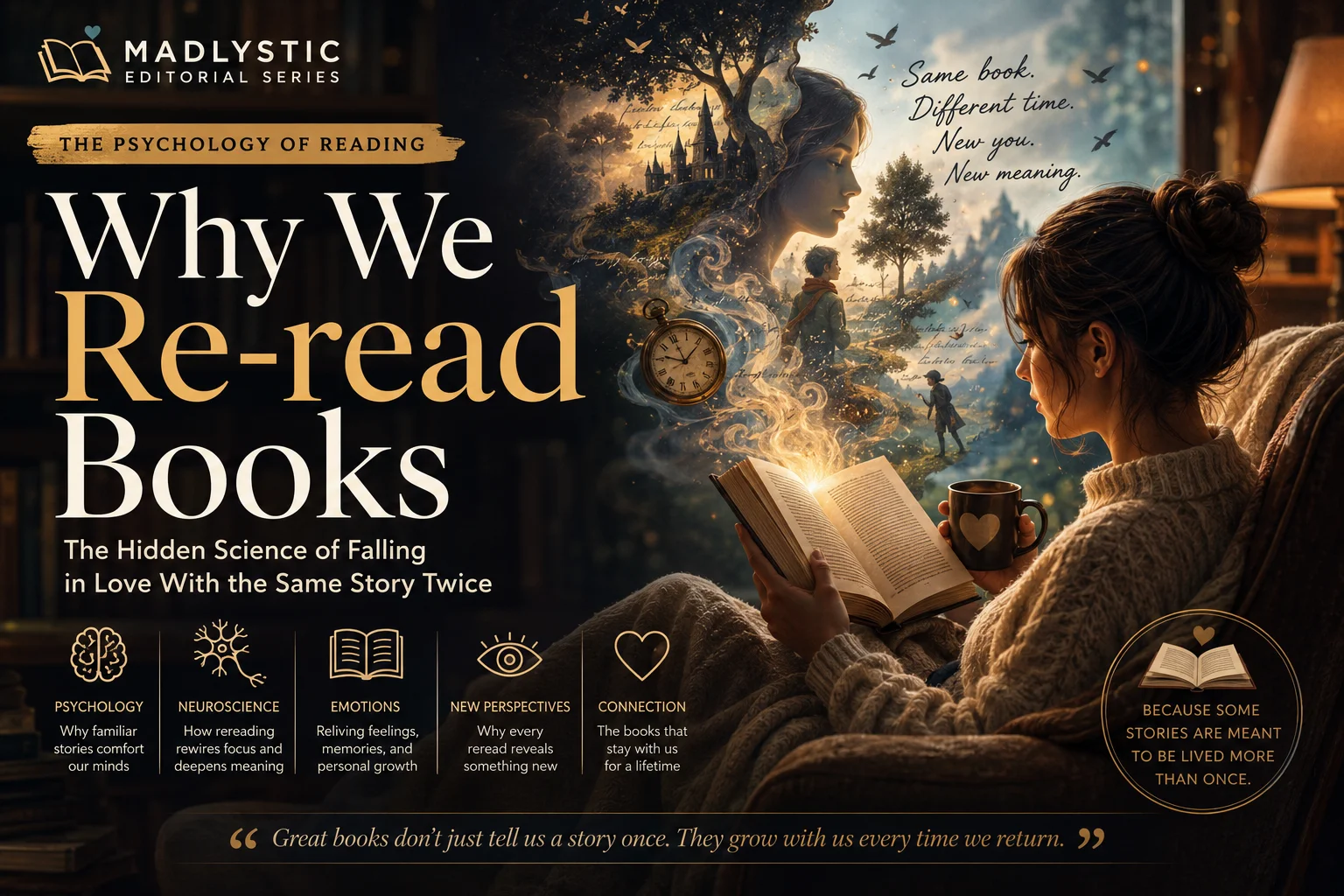
Why We Re-read Books: The Hidden Science of Falling in Love With the Same Story Twice
Why do millions of readers return to books they've already finished? Discover the fascinating psychology, neuroscience, and emotional reasons behind rereading favorite stories—and why every revisit reveals something new
Published July 18, 2026
Reading Time: 40–50 Minutes
Walk into any bookstore today, and you'll find thousands of books competing for your attention. New releases fill the front tables, bestseller lists change every week, and social media constantly introduces readers to the next must-read novel. There has never been a time in history when discovering new books was so easy.
Yet something curious happens when many readers return home.
Instead of picking up one of the countless unread books waiting patiently on their shelves, they reach for a novel they've already finished. Perhaps it's a worn copy of Harry Potter and the Philosopher's Stone, the timeless elegance of Pride and Prejudice, the haunting pages of The Book Thief, or the unforgettable journey through The Lord of the Rings. The cover may already be faded. The spine might barely hold together. Some pages are marked with notes written years ago by a younger version of themselves.
And still, they begin reading from page one.
At first glance, this habit seems almost irrational.
Why spend twenty hours rereading a story when there are millions of books you've never experienced? Why revisit an ending you already know instead of discovering something entirely new?
The answer lies far deeper than simple nostalgia.
Every time we reread a book, we aren't merely revisiting a story—we're revisiting ourselves.
The words remain exactly where they have always been. Every sentence, every chapter, every heartbreaking farewell and joyful reunion is unchanged. What changes is the person holding the book.
The teenager who first read George Orwell's 1984 may have focused on its thrilling rebellion. Reading it again as an adult often reveals a much darker reflection on politics, surveillance, truth, and freedom. Someone who adored The Little Prince as a child might return decades later and suddenly understand why adults in the story seem so lost. A parent rereading Charlotte's Web with their child may discover themselves crying over passages they barely noticed years earlier.
Great books possess a remarkable quality: they seem to grow as we grow.
Unlike films or television, reading demands active participation. Every page asks readers to imagine faces, voices, landscapes, emotions, and conversations. Because our own experiences shape those mental images, the same book can feel entirely different depending on when we read it.
This is why rereading isn't simply about reliving an old adventure.
It's about discovering new meanings hidden inside familiar pages.
More Than a Habit—A Universal Experience
If you've ever felt guilty about rereading a favorite novel instead of tackling your ever-growing "To Be Read" pile, you're far from alone.
Across the world, millions of readers intentionally return to books they've already completed. Browse any online reading community, and you'll find annual rereading challenges, discussions about "comfort books," and passionate debates about which novels deserve a second—or tenth—visit.
Interestingly, this isn't limited to classic literature.
Fantasy readers frequently return to The Hobbit before beginning another epic adventure. Mystery lovers revisit Agatha Christie's carefully crafted puzzles, even though they already know the murderer. Romance readers often reread novels where every emotional twist is already familiar. Fans of literary fiction return to works like A Man Called Ove or The Kite Runner, fully aware of the emotional impact waiting ahead.
The enjoyment isn't reduced by knowing what happens.
If anything, knowing the ending often changes how the story is experienced.
Imagine visiting a famous city for the first time.
You're busy finding your way, reading maps, checking directions, and making sure you don't miss the major landmarks. The second visit feels completely different. Without the pressure of figuring everything out, you begin noticing the quiet cafés tucked between busy streets, the architecture above shop windows, the conversations of local people, and countless details that escaped your attention the first time.
Books behave in remarkably similar ways.
During a first reading, readers naturally focus on one question:
"What happens next?"
During a reread, that question disappears.
Instead, attention shifts toward subtler experiences.
You notice the carefully placed hints hidden in early chapters.
You appreciate dialogue that once seemed ordinary but now carries deeper meaning.
You recognize moments of foreshadowing that quietly predicted events hundreds of pages later.
Characters who appeared insignificant suddenly become essential pieces of the story's larger design.
It's almost like watching a master magician perform after you've learned the secret behind the trick. The mystery changes, but admiration often grows stronger.
The Comfort Hidden Between Familiar Pages
Not every rereading experience begins with literary curiosity.
Sometimes it begins with exhaustion.
Life has a way of becoming unpredictable. New jobs, exams, heartbreaks, family responsibilities, financial worries, health concerns, and countless daily pressures can leave people mentally overwhelmed. During these periods, many readers instinctively seek something familiar.
A familiar meal.
A familiar song.
A familiar movie.
Or a familiar book.
Psychologists often describe this as a natural response to uncertainty. While the outside world constantly changes, familiar experiences provide a sense of stability and emotional safety.
Books can become emotional anchors.
Opening a beloved novel feels like returning to a place where nothing unexpected will happen. The characters are familiar companions. Their journeys remain unchanged regardless of what is happening in our own lives.
Readers often describe these novels as comfort books.
Unlike books chosen purely for literary excellence, comfort books are deeply personal. Two readers may completely disagree about which novel is "better," yet both may treasure different books for reasons that have little to do with critical acclaim.
Someone might return to Anne of Green Gables because it reminds them of childhood summers spent reading with their grandparents.
Another reader may revisit The Chronicles of Narnia every winter because it brings back memories of school holidays.
Others find unexpected peace in novels like The Alchemist, The Secret Garden, or Little Women, not because they're searching for surprises, but because these stories have become part of their emotional landscape.
The comfort doesn't come from predictability alone.
It comes from familiarity.
We already know these characters.
We trust them.
And in an uncertain world, trust is surprisingly comforting.
Why Children Teach Us One of Reading's Greatest Lessons
If you've ever read to a young child, you've probably experienced something that initially seems impossible.
The child asks for the same bedtime story.
Again.
And again.
And again.
Even after hearing the story dozens of times, they still laugh at the same funny moments, become excited during the same adventures, and ask the exact same questions.
Adults often wonder why children don't become bored.
Developmental psychologists have studied this behavior for decades, and their findings offer an interesting insight into human nature.
Children don't reread stories because they forget them.
They reread because familiarity creates confidence.
Knowing what comes next allows them to focus on emotions, language, imagination, and tiny details they previously overlooked. Familiar stories also help children process new experiences while feeling safe inside a predictable narrative.
Interestingly, this habit doesn't disappear as we grow older.
It simply changes form.
Adults no longer ask for the same bedtime story every night.
Instead, we quietly return to the novels that once shaped us.
The books may be different.
The reason is remarkably similar.
We're searching for familiarity in an ever-changing world.
And perhaps, without realizing it, we're also searching for the person we were when we first turned those pages.
The Science Behind Seeing the Same Story Differently
One of the most fascinating aspects of rereading is that the story itself never changes—yet our experience of it almost always does.
Imagine watching the sunrise from the same hill every year. The landscape remains the same, but your perspective changes with every visit. One year you might notice the colors spreading across the sky. Another year you might pay attention to the birds beginning their morning songs. Years later, you may simply appreciate the silence.
Books work in much the same way.
The first time we read a novel, our attention is naturally consumed by the plot. We want answers.
Who is telling the truth?
Who will survive?
Will these two characters ever find each other?
How will everything end?
Because our minds are busy solving the story, countless smaller details quietly pass by unnoticed.
During a second reading, that urgency disappears.
Instead of racing toward the ending, readers begin appreciating everything that was happening in plain sight all along.
A single line of dialogue suddenly carries double meaning.
An innocent conversation turns out to be clever foreshadowing.
A character's strange behavior finally makes perfect sense.
Writers often spend months—or even years—carefully planting these subtle clues throughout their novels. On a first read, they're almost invisible. On a reread, they become one of the greatest pleasures of storytelling.
It's similar to listening to your favorite song hundreds of times. At first you remember only the chorus. Eventually you begin noticing the background instruments, the harmony, the lyrics, and tiny production details that make the song special.
Great books reward the same kind of attention.
Every Stage of Life Creates a Different Reader
One of literature's greatest mysteries is that the same book can feel completely different depending on when you read it.
Consider someone reading To Kill a Mockingbird at fourteen.
They may focus on Scout's adventures, childhood friendships, and the courtroom drama.
Read the same novel again twenty years later, and the story often transforms. Suddenly the reader notices Atticus Finch's quiet courage, the complexity of prejudice, the responsibility of parenthood, and the difficult moral choices that once seemed invisible.
Nothing inside the book has changed.
Life has simply given the reader new experiences through which to understand it.
The same transformation happens with countless classics.
Readers who first discover The Great Gatsby in school often remember glamorous parties and tragic romance. Years later they begin noticing loneliness, obsession, social class, and the illusion of the American Dream.
Children usually adore The Little Prince because of its whimsical adventures.
Adults often finish it with tears because they finally understand what Antoine de Saint-Exupéry was truly writing about.
This is one reason classic literature continues surviving across generations.
These books don't offer a single interpretation.
Instead, they patiently wait for readers to grow into new ones.
The Neuroscience of Rereading
While literature often feels magical, the human brain offers a fascinating scientific explanation for why rereading can be so rewarding.
When reading an unfamiliar book, our brains devote considerable energy to prediction and information processing. We constantly ask ourselves questions, build expectations, remember names, visualize locations, and connect clues across hundreds of pages.
It's mentally demanding.
During a reread, however, much of that cognitive effort disappears.
Because readers already understand the story's structure, the brain no longer needs to work as hard to predict what happens next. That extra mental space can instead focus on language, symbolism, emotional depth, and character psychology.
Researchers studying narrative comprehension have found that familiarity often allows readers to process stories more deeply rather than more superficially. Without the distraction of uncertainty, readers become more attentive to writing style, recurring themes, and emotional nuance.
This explains why many readers notice entirely new passages during a second or third visit—even though those words were always there.
Our attention has simply changed.
Famous Authors Who Loved Rereading
Rereading isn't merely a habit of passionate readers.
Many of history's greatest writers openly admitted that they returned to the same books throughout their lives.
C.S. Lewis believed that rereading great literature was essential because truly meaningful books reveal new layers every time we encounter them. He once suggested that we shouldn't hesitate to revisit stories that continue speaking to us.
Neil Gaiman has often discussed returning to beloved books throughout different stages of life, explaining that readers themselves change over time, allowing familiar stories to feel entirely new.
Stephen King, whose career has influenced generations of modern fiction writers, frequently recommends rereading classic novels—not simply for enjoyment, but to understand pacing, dialogue, character development, and storytelling craftsmanship.
Italian novelist Umberto Eco, known for The Name of the Rose, famously maintained an enormous personal library. He believed unread books represented future knowledge, but rereading important works remained equally valuable because understanding evolves throughout life.
These authors understood something aspiring writers sometimes overlook.
The first reading teaches you the story.
The second reading teaches you how the story was built.
Books That Almost Demand a Second Reading
Some novels are enjoyable from beginning to end.
Others become significantly richer after you've reached the final page.
George Orwell's 1984 transforms once readers recognize how carefully every chapter builds toward its devastating conclusion.
Donna Tartt's The Secret History openly reveals the central crime in its opening pages, shifting the focus away from "what happened" toward the far more interesting question of "why."
Kazuo Ishiguro's Never Let Me Go quietly plants emotional clues long before readers fully understand their significance.
Markus Zusak's The Book Thief, narrated by Death itself, gains extraordinary emotional weight during a reread because readers recognize countless moments of fragile hope hidden beneath everyday conversations.
Even fantasy masterpieces reward patient readers.
Returning to J.R.R. Tolkien's The Lord of the Rings often reveals astonishing levels of worldbuilding, mythology, language, and historical detail that many readers simply couldn't appreciate while following the enormous adventure for the first time.
These books weren't designed merely to entertain once.
They were written to stay with readers for decades.
Why Writers Should Re-read More Than They Write
Many aspiring authors focus almost entirely on producing new words.
Professional writers often spend just as much time studying existing ones.
Rereading great novels offers lessons that first readings rarely provide.
Writers begin asking entirely different questions.
Why did this chapter end here?
Why was this character introduced so early?
How did the author create tension without revealing too much?
Why does this conversation feel so natural?
Where was the turning point hidden?
Instead of being absorbed by the story, writers start observing the architecture behind it.
It's similar to walking through a beautiful cathedral.
Visitors admire the stained glass.
Architects admire the engineering.
Neither perspective is wrong.
But the second reveals an entirely new level of appreciation.
The same principle applies to storytelling.
A second reading often transforms readers into students of craft.
And that's one reason many successful authors recommend rereading the books you admire most—not to imitate them, but to understand the countless invisible decisions that make unforgettable stories feel effortless.
Why Some Books Become Part of Our Identity
Think about the books you recommend most often.
They probably aren't simply the "best-written" books you've ever read.
They're the books that arrived at exactly the right moment.
Perhaps a novel gave you hope during a difficult year. Maybe a memoir encouraged you to pursue a new career. A fantasy series became your escape during stressful exams. Or a coming-of-age story helped you feel understood when you believed no one else could.
Over time, these books stop being mere entertainment.
They become landmarks in our personal histories.
When we reread them years later, we're not only revisiting fictional worlds—we're reconnecting with earlier versions of ourselves.
You remember where you bought the book.
You remember who recommended it.
You remember reading late into the night because you couldn't put it down.
You remember laughing, crying, or staring silently at the final page after finishing.
In many ways, rereading becomes a conversation between your past and present selves.
The story acts as the bridge.
Is It Better to Read Something New or Re-read an Old Favorite?
Readers often ask this question as if there must be a correct answer.
Should you spend your limited reading time discovering new books?
Or should you return to the stories you already love?
The truth is that both experiences offer different rewards.
Reading a new book expands your literary horizons. It introduces unfamiliar ideas, perspectives, cultures, writing styles, and characters. Every unread book carries the excitement of discovery.
Rereading, on the other hand, offers depth rather than novelty.
Instead of asking, "What's going to happen?", it asks, "What did I miss?"
Neither choice is superior.
A healthy reading life usually includes both.
Many readers alternate between exploring something completely new and revisiting an old favorite. One challenges curiosity; the other provides comfort and reflection.
The unread books on your shelf promise new adventures.
The worn books beside them remind you where you've already been.
There is room for both.
Digital Books Haven't Changed This Habit
The rise of ebooks, audiobooks, and digital libraries has transformed how people read, but it hasn't changed why they reread.
Whether the pages are made of paper or displayed on a screen, readers still return to familiar stories.
In fact, digital reading has made rereading easier than ever.
Bookmarks sync across devices.
Highlights remain saved for years.
Favorite passages can be searched instantly.
Audiobooks allow readers to revisit beloved novels during commutes, workouts, or evening walks.
Technology has changed the format, but not the emotional connection.
The desire to revisit meaningful stories remains timeless.
Why Great Books Never Truly End
One of the greatest achievements of literature is that exceptional books continue living long after the final chapter.
Readers discuss them.
Recommend them.
Quote them.
Gift them to friends.
Pass them to children.
Then, years later, they quietly read them once again.
This is perhaps the highest compliment any author can receive.
Not that someone finished the book.
But that someone chose to return.
Again and again.
A bestseller might dominate headlines for a few months.
A beloved book quietly stays on someone's shelf for decades.
Its pages become softer.
Its cover fades.
Its corners bend.
Yet with every rereading, it somehow feels alive again.
That is the quiet power of literature.
Did You Know?
📚 The word "bibliophile" refers to someone who loves books, but many lifelong bibliophiles say rereading favorite books is just as enjoyable as discovering new ones.
📖 Children often request the same bedtime story repeatedly, helping them build language skills, emotional confidence, and familiarity with storytelling patterns.
🧠 Your interpretation of a novel changes with life experience. The same story can feel entirely different at age 15, 30, or 60 because readers bring new knowledge, memories, and emotions to every reading.
✍️ Many professional authors reread classic novels throughout their careers to study pacing, dialogue, structure, and character development—not simply for entertainment.
🌍 Some of the world's most celebrated classics have remained in print for generations largely because readers continue recommending and rereading them long after their first publication.
Quote of the Article
"A truly great book doesn't change with time—the reader does. Every rereading reveals not only new pages, but a new version of ourselves."
Key Takeaways
Great books reward rereading by revealing new themes, details, and emotions.
Life experiences change how readers interpret the same story.
Familiar books often provide emotional comfort during uncertain times.
Writers can learn storytelling techniques by rereading favorite novels with a critical eye.
Rereading and discovering new books serve different but equally valuable purposes.
The books we return to often become part of our personal identity and memories.
Final Thoughts
In a world that constantly encourages us to chase the next new thing, rereading reminds us that not everything valuable is found by moving forward.
Sometimes the greatest discoveries are waiting inside stories we already know.
A familiar novel can become a mirror, reflecting how much we've changed since we first turned its pages. Characters we once admired may challenge us. Scenes we barely noticed may become unforgettable. Entire themes may emerge that seemed invisible years before.
That is the quiet magic of literature.
A truly remarkable book doesn't ask to be read only once.
It patiently waits on the shelf, knowing that when the time is right, you'll return—not because you've run out of stories, but because you've become ready to understand this one in a completely new way.
So the next time you find yourself reaching for a well-worn favorite instead of an unread bestseller, don't think of it as reading the same story again.
Think of it as meeting an old friend after years apart.
The friend hasn't changed.
But you have.
And that is why every rereading becomes a brand-new journey.
Share this article
Share this article with readers who'll want to read it.