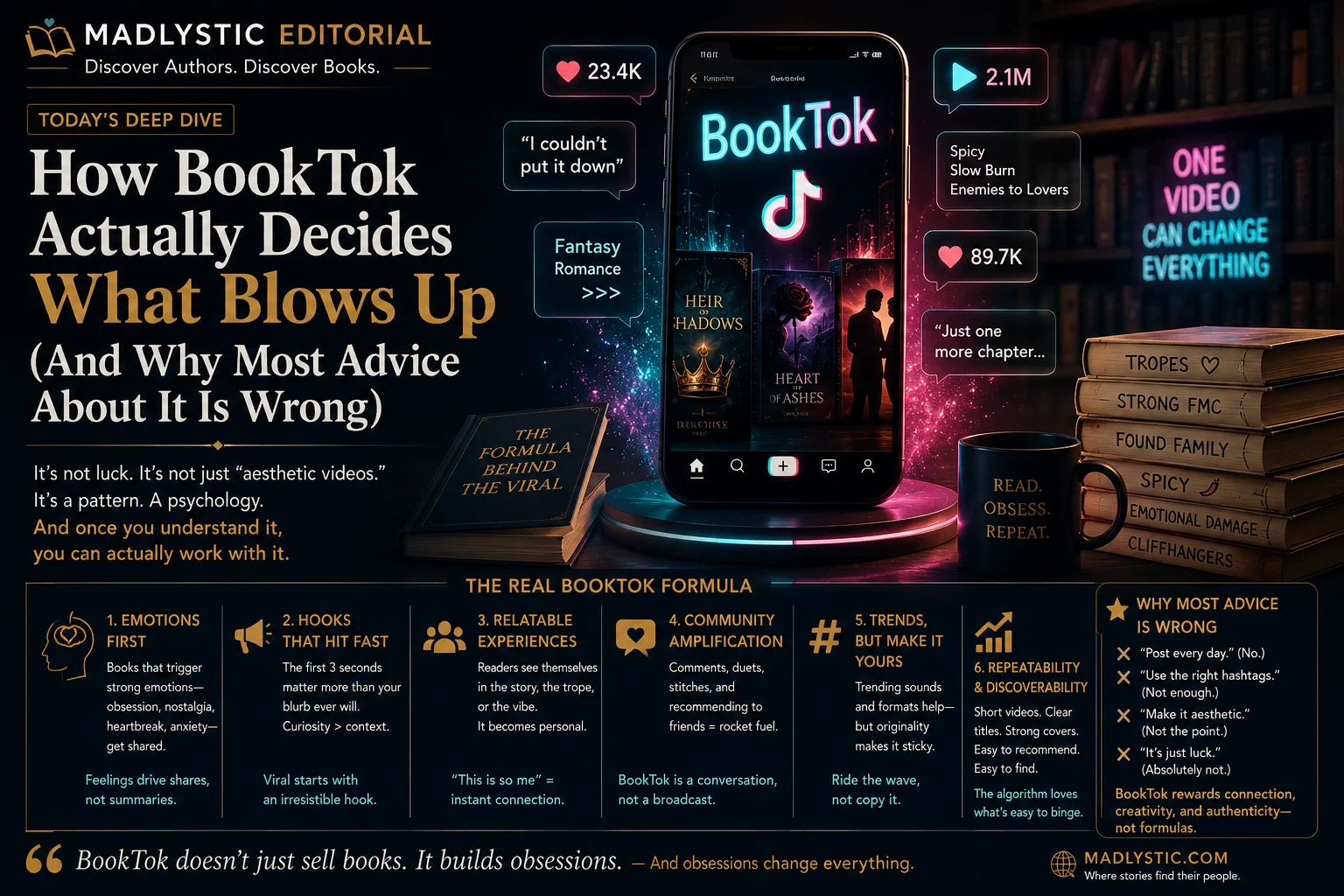
How BookTok Actually Decides What Blows Up (And Why Most Advice About It Is Wrong)
BookTok has sold hundreds of millions of books, and most authors still misunderstand exactly how it decides which ones. Here's what the algorithm is actually rewarding — and why chasing virality is the wrong goal entirely.
Published July 19, 2026
12 min read
Quote of the Day
"Word of mouth is the oldest advertising there is — BookTok just made it visible at scale." — a sentiment widely echoed across the publishing industry as BookTok's influence became undeniable.
Somewhere on TikTok right now, a book that came out five years ago, sold modestly, and was quietly forgotten by everyone except its author is climbing a bestseller list it never touched at launch. This isn't a rare fluke. It's become one of the most well-documented patterns in modern publishing, and it happens because of something most authors fundamentally misunderstand about how BookTok actually works.
The case that changed everything
If there's one story every author has heard secondhand, it's Colleen Hoover's It Ends With Us. Published in 2016 to a respectable but unremarkable reception, the novel sat quietly for years. Then, five years after release, it experienced a surge — roughly a 70% jump in readership that pushed it to number one on bestseller lists in 2021, driven almost entirely by organic BookTok discussion rather than any new marketing push from its publisher. ManuscriptReport
That timeline matters more than the outcome. Nothing about the book changed in those five years. What changed was that a platform existed where readers could stumble onto emotional, specific, personally-voiced discussion of the book, and that discussion compounded on itself in a way no traditional marketing channel could replicate. The book didn't go viral because of a marketing campaign. It went viral because BookTok, structurally, rewards exactly the kind of content ordinary readers make for free: someone crying on camera about a plot twist, someone reading their favorite line out loud, someone explaining why a specific scene wrecked them.
This is the case study every "BookTok strategy" article eventually references, and for good reason — it's the clearest proof that discovery on this platform runs on a completely different logic than shelf placement, review counts, or advertising spend ever did.
What the algorithm is actually optimizing for
Here's the part that gets lost in most advice about "cracking the BookTok algorithm": TikTok's recommendation system has exactly one job, and it isn't "help authors sell books." Its job is keeping people watching. Every single ranking decision — what gets shown to more people, what gets buried after a few hundred views — flows from a prediction about whether a specific viewer will watch longer, engage more, and come back tomorrow.
This sounds like a minor technical distinction, but it changes everything about strategy. Unlike Instagram or Amazon's own algorithms, which weight follower count and past sales heavily, TikTok's system favors recent video performance over follower count, analyzing engagement patterns and content preferences to build a personalized feed for each individual viewer. A brand-new author with forty followers and a genuinely compelling fifteen-second hook can outperform an account with fifty thousand followers posting something generic. That's not a loophole. It's the actual design of the system.
One writer covering this space for authors put it in a useful way: the algorithm behaves less like a gatekeeper trying to suppress unknown authors, and more like an eager but literal-minded assistant that's waiting for clear signals about exactly which readers to send a given video to. Post something genre-ambiguous, tonally confused, or trying to appeal to everyone at once, and the algorithm has nothing clear to work with. Post something with an unmistakable, specific hook — a trope, a mood, a single emotional beat — and it has exactly what it needs to find the narrow slice of viewers who'll actually stop scrolling for it.
The numbers, and why they're bigger than most authors assume
It's worth being specific about scale here, because "BookTok is big" undersells what's actually happened. In 2021 alone, BookScan data showed the platform helped drive roughly 20 million printed copies sold, a figure that grew by another 50% the following year. The #BookTok hashtag itself has accumulated an enormous volume of dedicated video content over the platform's lifespan, spanning everything from YA fantasy to romance to literary fiction discussion. Annalise Reads
The genre spread matters as much as the raw numbers. BookTok is often assumed to be a romance-only phenomenon, largely because romance's most viral moments get the most mainstream press coverage. But the actual community spans far wider — discussions ranging from coming-of-age stories and YA fantasy to identity narratives, mental health, and diverse voices across genres all have active, engaged corners of the platform. The romance dominance in press coverage is a visibility bias, not an accurate map of where the actual discovery activity happens.
Why "just post consistently" is true and also incomplete advice
Ask ten different sources for BookTok strategy and nine of them will tell you to post consistently, and they're not wrong — but the reasoning behind that advice usually gets skipped, which is why it often doesn't land. Consistency isn't valuable because the algorithm rewards effort for its own sake. It's valuable because the system needs a repeated, clear signal about what an account is actually about before it can confidently route the right viewers toward it. A single viral video from an account with no other genre-consistent content is a fluke the algorithm has no reason to repeat. A steady stream of clearly-genred, consistently-toned content gives the system something to learn from and build on.
This is also where a lot of authors sabotage themselves without realizing it. Posting three videos in a genuine niche, getting modest views, then pivoting to chase whatever trend is currently popular regardless of fit, resets the very signal the algorithm was starting to learn. The advice to "stay consistent" really means: give the system a clear, stable pattern long enough for it to find your actual readers, rather than a new pattern every week that never has time to compound.
There's a second layer worth naming honestly: BookTok, several years into its existence, has matured past its earliest wild-west phase. By most industry accounts, it remains the single most powerful organic book-discovery channel available to indie authors, while also being a platform with real limits — it rewards a specific video style, demands consistency, and works dramatically better for some genres than others. A quiet, slow-burn literary novel forcing itself into a hook-driven fifteen-second format is fighting the platform's native grammar rather than working with it. Recognizing when a book's actual tone doesn't fit BookTok's format is as important a strategic decision as recognizing when it does. ScribeCount
What actually correlates with conversion, not just views
Views are the easiest number to chase and the least useful one to optimize for in isolation. Roughly 45% of TikTok users report having purchased a book after seeing it on the platform, and books featured on BookTok have shown an average sales increase of around 600% — but those numbers describe outcomes downstream of something more specific than raw view count: genuine emotional engagement from viewers who feel like the content came from an actual person rather than an advertisement. ManuscriptReport
This is the pattern across nearly every documented BookTok success story: the content that converts isn't polished. It's a reader crying about a betrayal scene, an author reading their own favorite line in a voice memo quality clip, an unfiltered reaction video. The platform's culture actively rewards authenticity and punishes anything that reads as a disguised ad — which is a genuinely different set of instincts than the polished, professional marketing content that worked on other platforms for the last decade.
Where this leaves an indie author with no following
None of this requires an existing audience, a marketing budget, or a background in video content — which is precisely why it matters for indie authors specifically. The entry cost is a phone, a genuine reaction to your own book, and a willingness to post before you feel ready. The barrier isn't resources. It's the discomfort of being visible and specific before you have any proof it'll work.
The practical starting point is narrower than most guides suggest: pick one true, specific, emotionally real thing about your book — a trope it delivers on, a line that surprised even you while writing it, a moment you're genuinely proud of — and make one video about exactly that, with no attempt to summarize the whole book or sell it broadly. Post it. Watch what happens to the handful of people who see it. Do that again, in the same genre lane, for several weeks before drawing any conclusions. The algorithm needs repetition to learn a pattern; most authors give up before it's had the chance to.
This is also, structurally, the same discovery problem this platform has been circling in other articles — the cold-start problem, the flywheel that needs a first push by hand before any system helps carry it further. BookTok is simply one of the more effective, most human ways to manufacture that first push at zero cost, provided the content is genuinely specific rather than generically promotional. And for readers who do discover a book this way, having a stable, well-organized destination to land on afterward — a clear author profile, a full catalog, a place to follow for what's coming next — is exactly the kind of infrastructure discovery platforms like Madlystic are built to provide once that initial spark of interest exists.
Conclusion
BookTok didn't create a new kind of reader. It created a visible, searchable record of something that was always true and always invisible before now: readers have always talked to each other about books that moved them, and that word-of-mouth conversation has always been the real engine behind which books eventually found a wide audience. What changed is that this conversation now happens in public, at scale, in a format an algorithm can measure and amplify. Understanding that — really understanding it, not just repeating "post consistently" as a slogan — is the difference between chasing virality as a lottery ticket and building the kind of specific, genuine, repeated signal that a system designed to find the right readers can actually act on. The book doesn't need to be perfect to work here. It needs to be described, on camera, by someone who actually means it.
Share this article
Share this with readers who'll want to know.
You may also like

How to Write a Book Description That Sells (With Examples)
November 19, 2026

How to Get Book Reviews on Amazon Without Breaking Rules
November 17, 2026
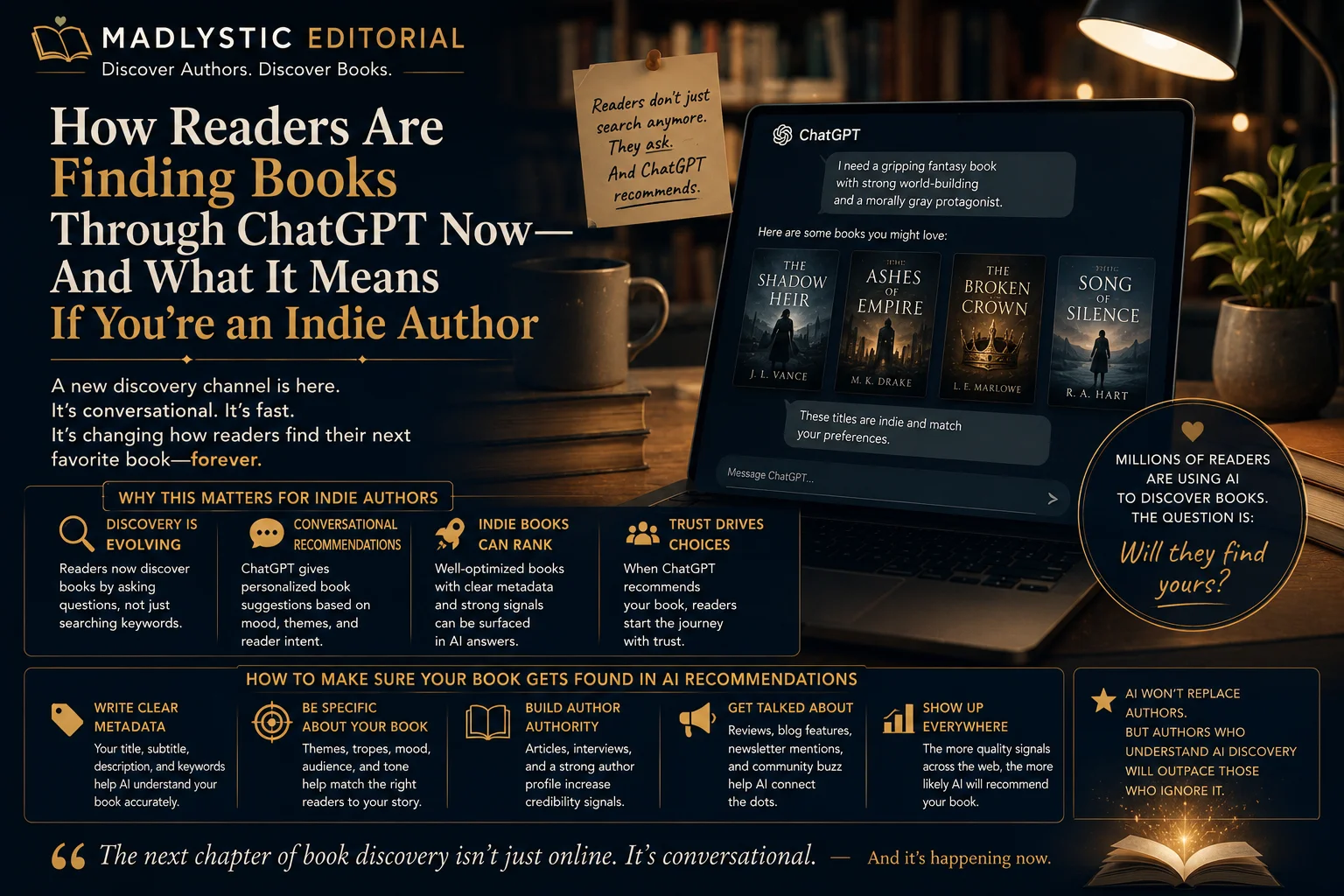
How Readers Are Finding Books Through ChatGPT Now — And What It Means If You're an Indie Author
July 19, 2026

Traditional Publishing vs. Self-Publishing: Which Is Right for You?
November 24, 2026