How to Write a Book Description That Sells (With Examples)
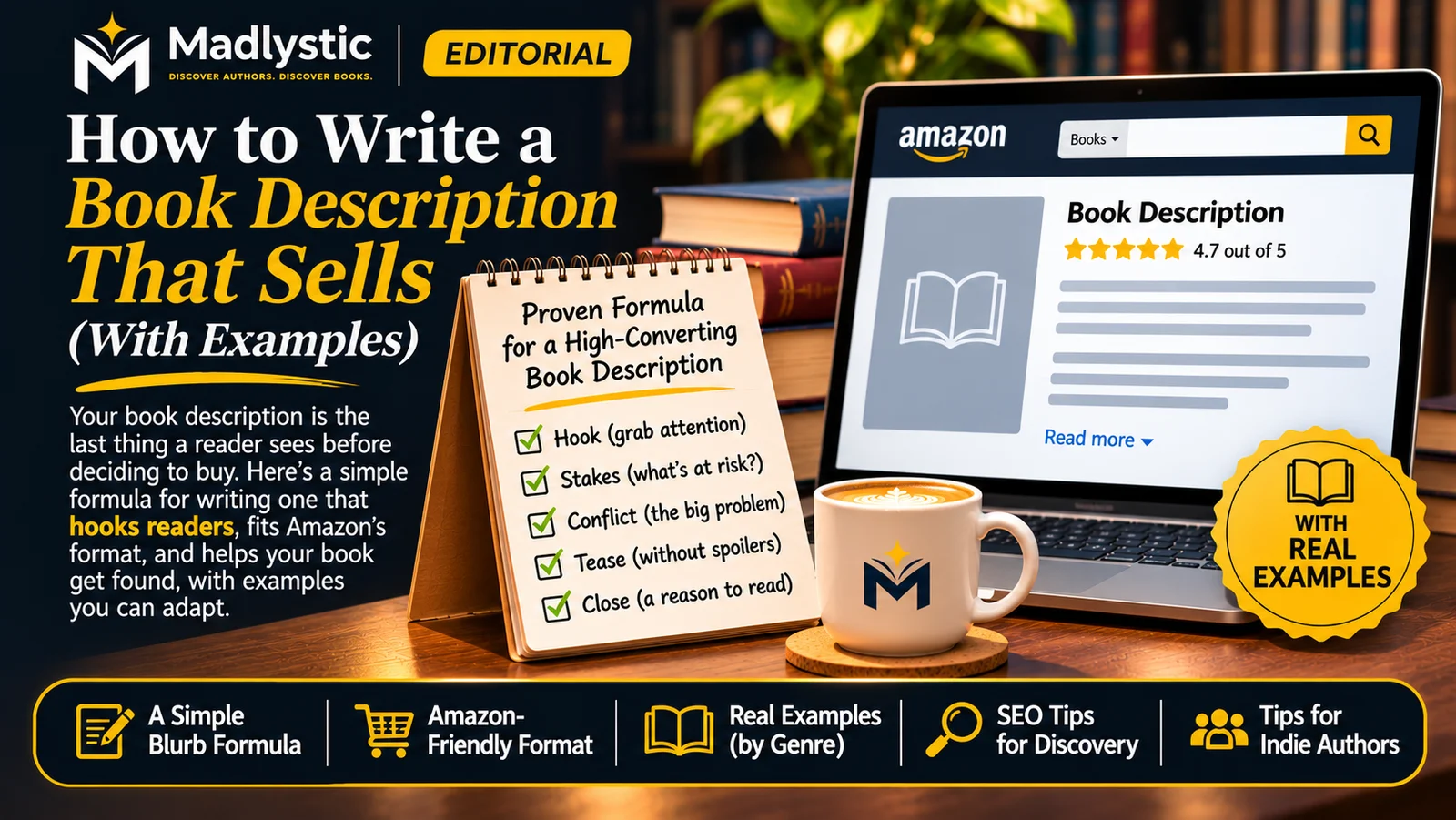
Your book description is the last thing a reader sees before deciding to buy. Here’s a simple formula for writing one that hooks readers, fits Amazon’s format, and helps your book get found, with examples you can adapt.
Published November 19, 2026
9 min read
Quote of the Day
“I try to leave out the parts that readers tend to skip.” — Elmore Leonard
A reader finds your book. The cover catches their eye. They click. Now they have about ten seconds with your description before they decide to buy, borrow, or keep scrolling. That short block of text may be the most important writing you do after the book itself, and it’s the part most authors rush.
What a book description actually needs to do
A book description isn’t a summary. Its job is to make the right reader feel, “I need to know what happens.” A good one does three things:
Tells readers what kind of book this is, so the right audience recognizes it immediately.
Introduces a character and a problem they care about.
Raises a question the reader can only answer by reading the book.
If a reader finishes your description knowing the ending, it has done too much. If they finish it unsure what genre the book is, it has done too little.
The simple formula
Most strong fiction descriptions follow the same shape, in roughly 150 to 250 words:
The hook (one or two lines). A striking opening line that sets the tone and grabs attention.
The character and situation. Who is this about, and what’s their world like when the story begins?
The conflict. What goes wrong, and what does the character want?
The stakes. What happens if they fail?
The question. End on the choice, the danger, or the mystery, not the answer.
Optional positioning line. For example, “Perfect for fans of slow-burn romantasy and morally gray heroes.”
A worked example
Here’s a description for an invented fantasy novel, written using the formula:
She was born to burn the kingdom. He was sworn to stop her.
In the city of Varnhal, fire magic is a death sentence, and Kaela has hidden hers for nineteen years. But when a royal festival goes wrong and flames tear through the palace, every eye turns toward her.
Captain Riven Ashford is ordered to bring her in before the next full moon. The problem: the closer he gets, the more he suspects she isn’t the one who started the fire.
With the city on the edge of war and a killer still hiding in the court, Kaela and Riven must decide who to trust, before the real arsonist burns everything they love.
Perfect for readers who love enemies-to-lovers romance, hidden magic, and a slow-burn mystery.
Notice what it leaves out: the backstory, the full magic system, and the ending. It gives just enough to make the right reader curious.
Write for the first two lines
On Amazon, only the opening part of your description is visible before readers click to read more. That means your first one or two lines carry most of the weight. Avoid opening with:
Generic praise, such as “A gripping, unforgettable story.”
Background, such as a history of your fictional world.
Vague questions, such as “What would you do if your life changed forever?”
Open instead with something specific: a striking situation, a sharp line of conflict, or an image only your book could have.
Make it skimmable
Readers skim descriptions, especially on phones. Keep paragraphs short, usually one to three sentences. Use bold for your hook line. Amazon’s KDP description field supports basic formatting such as bold and italics, so use it lightly to guide the eye, not to decorate every line.
Use words readers actually search for
Your description helps people find your book, not just decide to buy it. Mention your genre and key tropes naturally, the way a reader would describe the book to a friend, such as “enemies to lovers,” “cozy mystery,” or “found family.” This matters more than ever now that readers ask AI tools for recommendations, which we explain in how readers are finding books through ChatGPT. Don’t stuff keywords, though. A description that reads like a list of tags turns readers away.
Common mistakes to avoid
Telling the whole plot. If the description covers the climax, readers have no reason to buy.
Too many names. Introduce one or two characters at most. A list of names is hard to follow.
Comparing yourself to bestsellers you don’t resemble. “The next Harry Potter” sets expectations your book may not match. Honest, specific comparisons work better.
Writing it in a hurry. Many authors spend years on a book and ten minutes on its description. Draft several versions and read them aloud.
Descriptions vs. cover blurbs
A book description is different from the short quotes on a cover, which come from other authors or reviewers. We explain how those work in the broken system behind every “unputdownable” cover quote. Your description is your own pitch, in your own voice.
Test, then improve
Your description isn’t set in stone. If a book gets plenty of page views but few sales, the description is often the first thing worth rewriting. Change one thing at a time, such as the hook line, and give it a few weeks before judging the result. For where descriptions fit in your publishing process, see our step-by-step KDP publishing guide, and once sales start, our guide to getting honest Amazon reviews.
Want readers to find your description outside Amazon too? Create your free author page on Madlystic and use the same description there, since consistent descriptions across platforms help both readers and search engines recognize your book.
Conclusion
A good book description doesn’t explain your book. It makes the right reader need it. Lead with a specific hook, introduce one character and one problem, raise the stakes, and stop before you give away the answer. Then read it aloud, cut everything a reader would skip, and let the story do the rest.
Frequently Asked Questions
How long should a book description be?
Most fiction descriptions work best at around 150 to 250 words. Long enough to set up the character, conflict, and stakes, and short enough to read in under a minute.
What’s the difference between a book description and a blurb?
People often use the words interchangeably. In publishing, a “blurb” can also mean a short endorsement quote from another author, while the description is your own summary and pitch for the book.
Should a book description include spoilers?
No. A description should set up the story and raise a question, not reveal the ending or major twists.
Should I write my book description in first or third person?
Most fiction descriptions are written in third person and present tense, even if the book itself is in first person. Some genres, especially romance, sometimes use first-person hooks for effect.
Can I change my Amazon book description after publishing?
Yes. You can update it in KDP at any time, which makes it one of the easiest things to test and improve.
Share this article
Share this article with readers who'll want to read it.