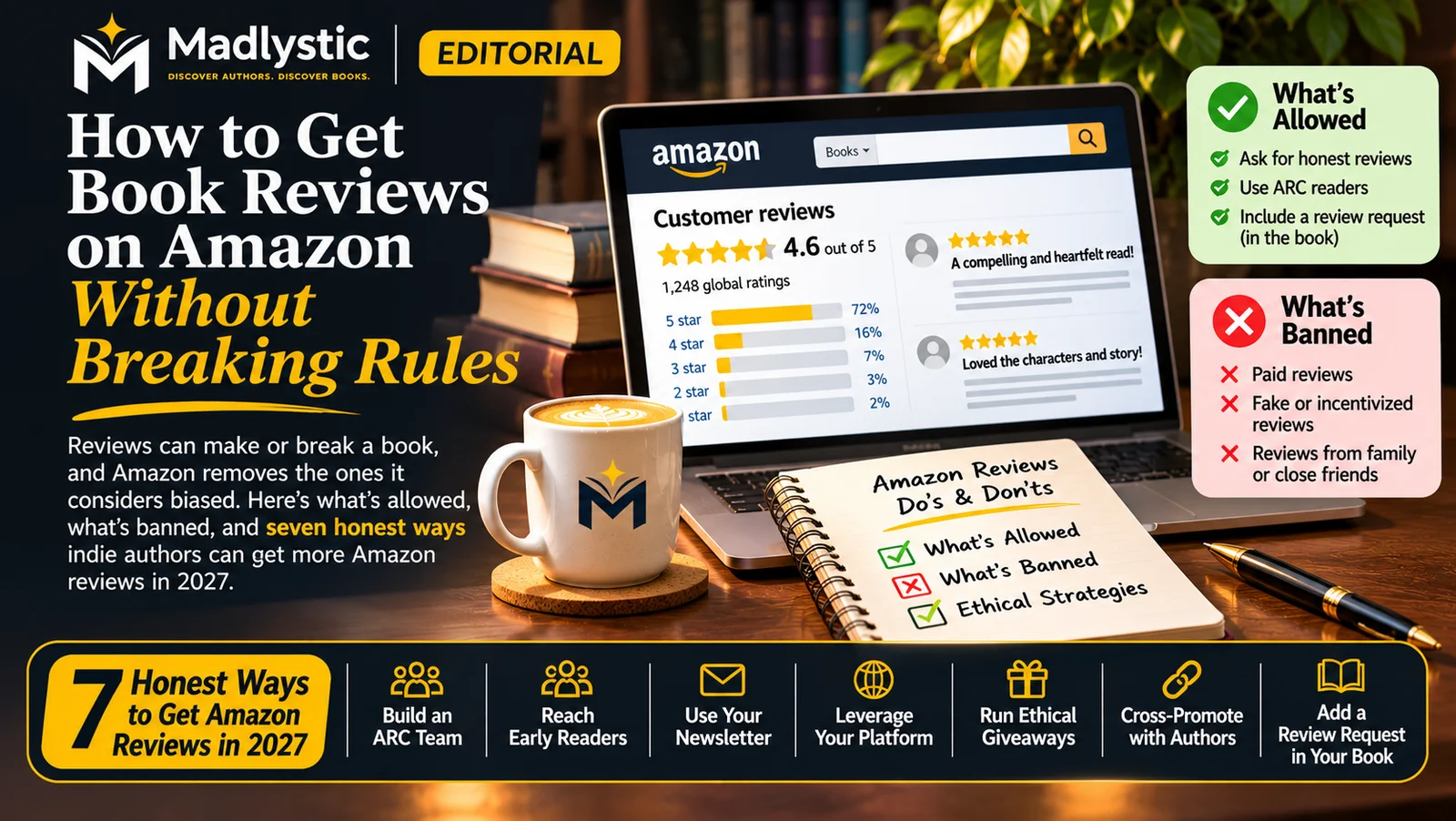
How to Get Book Reviews on Amazon Without Breaking Rules
Reviews can make or break a book, and Amazon removes the ones it considers biased. Here’s what’s allowed, what’s banned, and seven honest ways indie authors can get more Amazon reviews in 2027.
Published November 17, 2026 · 12 views
10 min read
Quote of the Day
"Authors can't require a review in exchange." — a plain summary of the most important line in Amazon's review rules for advance copies
Reviews are the social proof that turns a curious browser into a buyer. They're also one of the easiest places for an indie author to get into trouble. Amazon removes reviews it considers biased, and authors who break the rules can lose reviews they worked hard for. Here's what's actually allowed, and how to build reviews the honest way.
Amazon's rules change from time to time. This guide reflects common guidance as of November 2026, so always check Amazon's current Community Guidelines before running a review campaign.
What Amazon doesn't allow
Amazon wants reviews from readers with no personal or financial interest in a book. These are the practices most likely to get reviews removed:
Paying for customer reviews. Any payment, gift card, or discount in exchange for a review is banned.
Review swaps. "I'll review your book if you review mine" counts as coordinated manipulation, even between honest authors.
Reviews from family, close friends, or business associates. Amazon treats these as conflicts of interest, even when the reviewer is being honest.
Requiring or steering reviews. You can't demand a review, ask only for positive reviews, or tell readers what to say.
Fake or AI-written reviews. These are banned outright.
What Amazon does allow
Advance reader copies (ARCs). You can give free copies to readers before or after launch, as long as a review is optional and you don't steer what they say. Reviewers should disclose that they received a free copy.
Asking readers politely. A note at the end of your book inviting readers to leave an honest review is fine, as long as there's no incentive attached.
Editorial reviews. Professional reviews, including paid ones from established review services, can appear in your book's separate Editorial Reviews section, credited to the reviewer. They are not customer reviews.
Amazon Vine. This is Amazon's own invitation-only review program, where selected reviewers receive free products. It's generally offered through Amazon's seller and vendor programs rather than standard KDP, so most self-published authors won't have direct access to it.
The rule that confuses most authors: Amazon's spending requirement
If an ARC reader tells you "Amazon won't let me post my review," this is usually why. In the US, Amazon generally requires customers to have spent at least $50 on Amazon in the past 12 months, using a valid credit or debit card, before they can leave customer reviews. Promotional discounts typically don't count toward that total. The exact requirement can vary by country, so readers outside the US should check their local Amazon site.
It's worth mentioning this to your ARC team upfront, so readers aren't confused and you aren't left wondering why reviews never appear.
7 honest ways to get more Amazon reviews
1. Build an ARC team
Recruit readers who enjoy your genre and send them free advance copies before launch. Make it clear that a review is welcome but optional. Read our guide to what ARCs are and how they work.
2. Use ARC platforms
Services such as BookSirens and NetGalley connect authors with readers who request review copies. Smaller platforms are often more affordable for indie authors.
3. Add a review request to the back of your book
Readers are most likely to leave a review the moment they finish. A short, friendly note at the end of the book, with no incentive, catches them at exactly that moment. You can use this example as a starting point:
Thank you for reading! If this story stayed with you, leaving an honest review on Amazon helps other readers discover the book, and it means the world to an independent author.
4. Reach out to book bloggers and creators
Bloggers, Bookstagrammers, and BookTok creators in your genre often accept review copies. Personalize every request and respect their review policies.
5. Run a giveaway or free promotion
A free promotion, such as KDP Select's free days, puts your book in more readers' hands. Some of those readers will review it naturally.
6. Build a newsletter
Your newsletter readers are already interested in your work. Let them know when a new book launches and that honest reviews help.
7. Be patient with organic reviews
Most readers never leave reviews, so reviews build slowly. Steady, natural growth looks far healthier to Amazon than a sudden spike, which can trigger scrutiny.
Why shortcuts backfire
Rules exist because rankings depend on trust, and that trust gets tested constantly. We covered a famous example in how the New York Times bestseller list really works, where a debut novel was pulled from the list after suspicious bulk sales. Amazon reviews work the same way: shortcuts can work briefly, then get removed, sometimes taking honest reviews with them.
Where reviews fit in your bigger plan
Reviews matter most when readers can actually find your book. Pair your review strategy with good metadata, a strong description, and a place where readers can discover and follow you. You can create your free author page on Madlystic to showcase your books and keep all your links, including your ARC sign-up link, in one place.
Reviews also live beyond Amazon, as we explain in Goodreads vs. StoryGraph vs. newer discovery platforms. And if you're still preparing your launch, start with our step-by-step KDP publishing guide.
Conclusion
There's no honest shortcut to Amazon reviews, but there is an honest system: give real readers easy access to your book, ask politely without strings attached, and let the reviews come in their own time. It's slower than a paid service or a review swap, but every review you earn this way is one Amazon is likely to keep, and one future readers can actually trust.
Frequently Asked Questions
Can I pay for Amazon book reviews?
No. Paying for customer reviews is banned. Paid editorial reviews from professional services can appear in your book's Editorial Reviews section, but not as customer reviews.
Can my friends and family review my book on Amazon?
Amazon prohibits reviews from family members, close friends, and business associates, and often removes them. Ask them to support you in other ways, such as telling others about the book.
Are ARC reviews allowed on Amazon?
Yes, as long as the copy is free, the review is optional, and you don't influence what the reviewer says. Reviewers should disclose that they received a free copy.
Why can't my reader post a review on Amazon?
The most common reason is Amazon's spending requirement. In the US, customers generally need to have spent at least $50 on Amazon in the past 12 months, not counting promotional discounts, before they can leave reviews.
Can I swap reviews with other authors?
No. Amazon treats review swaps as manipulation, even if both reviews are honest.
How many reviews does a book need?
There's no official number. More honest reviews build reader trust, but steady, natural growth matters more than reaching any specific count.
Share this article
Share this article with readers who'll want to read it.
You may also like
How to Write a Book Description That Sells (With Examples)
November 19, 2026
Why Nobody Finds Your Book: The Real Mechanics of Indie Author Discovery
July 19, 2026

How BookTok Actually Decides What Blows Up (And Why Most Advice About It Is Wrong)
July 19, 2026
Traditional Publishing vs. Self-Publishing: Which Is Right for You?
November 24, 2026