The Warning Inside Your Paperback You've Never Noticed
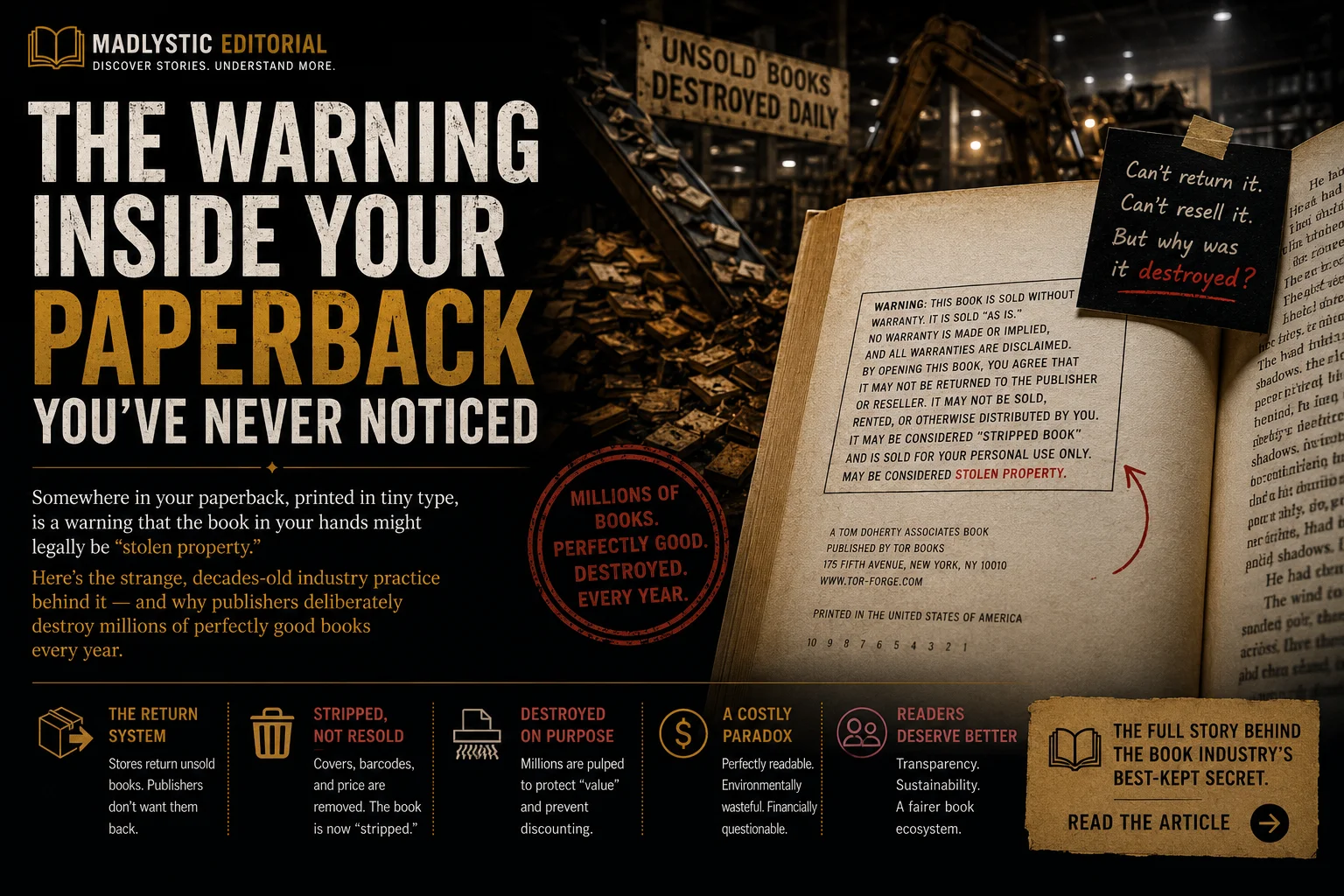
Somewhere in your paperback, printed in tiny type, is a warning that the book in your hands might legally be "stolen property." Here's the strange, decades-old industry practice behind it — and why publishers deliberately destroy millions of perfectly good books every year.
Published July 28, 2026
9 min read
Quote of the Day
"If you purchased this book without a cover you should be aware that this book is stolen property." — the standard stripped-book warning, printed quietly on the copyright page of nearly every mass-market paperback ever sold
Flip to the copyright page of almost any mass-market paperback — the small, rack-sized kind sold in airports, grocery stores, and drugstore spinners — and buried among the ISBN and printing information, there's often a strange little warning most readers have scrolled past their entire lives without registering: a note stating that if you bought this book without its cover, it's legally "stolen property," and neither the author nor the publisher was ever paid for it. It sounds like a strange overreaction to a coverless book. It's actually the visible fingerprint of one of publishing's stranger and more wasteful long-running practices — one that quietly results in millions of perfectly readable books being destroyed every single year.
The basic mechanic: returns nobody else's industry allows
Publishing operates on a business model almost no other consumer goods industry uses: books are sold to bookstores on consignment, meaning a store can order copies, display them, and then return whatever doesn't sell for a full refund or credit — a right of return that, say, a clothing retailer or electronics store simply doesn't get from its own suppliers. Industry estimates put the returned share of books at somewhere between 30% and 40% annually, and of those returns, an estimated 65% to 95% end up being destroyed by publishers rather than resold.
For a normal hardcover or trade paperback, that return is straightforward: the physical book gets shipped back to the publisher's warehouse, and depending on its condition, may get discounted and resold as a "remainder" (identifiable by that felt-tip marker line slashed across the page edges you may have seen on clearance shelves).
Where it gets strange: mass-market paperbacks don't get shipped back at all
Mass-market paperbacks — cheap to produce, at roughly $3.50 or less per copy, and sold in enormous volume — present a different math problem. Shipping an entire truckload of low-value, unsold paperbacks back to a warehouse can cost more than the books themselves are worth. So decades ago, likely as far back as the 1930s-40s when this format first became common, publishers and booksellers settled on a workaround: instead of shipping the whole book back, the bookstore simply tears the front cover off, mails just the lightweight cover back to the publisher as proof of destruction, and is contractually required to throw away, recycle, or otherwise destroy the actual pages themselves.
That's the entire mechanic behind that strange copyright-page warning. A stripped book — text block intact, cover ripped away — was never supposed to reach a reader at all. The publisher already issued the bookstore a refund on the assumption that book was destroyed. If it somehow survives and gets sold anyway (a real, documented, ongoing black-market practice at flea markets and some online marketplaces), neither the author nor publisher receives a cent for that sale, on top of already having effectively written off the copy as a loss.
Why booksellers themselves have pushed back on this for years
This isn't a practice booksellers universally defend either. One independent bookstore owner, writing candidly on Publishers Weekly's own industry blog, described being unable to bring herself to destroy a "perfectly good book" just because it needed to be returned — choosing to avoid stocking mass-market paperbacks specifically to sidestep the requirement, even at real cost to her own store's bottom line. Her question, echoed by others in the industry, cuts right to the heart of it: if publishers can handle trade paperback and hardcover returns without demanding physical destruction, why is the mass-market format treated so much more harshly?
The part that lands hardest: this connects directly to what authors actually get paid
This isn't just an environmental or logistical curiosity — it has a direct, painful link to author income, and it compounds a theme worth connecting to a related, common misunderstanding: a stripped book represents a copy the author was never paid for in any real sense. The publisher already gave the retailer credit for the "unsold and destroyed" copy, meaning the sale is reversed entirely from an accounting standpoint, regardless of how many trees, how much ink, and how much of an author's actual writing went into producing that physical object in the first place. As one industry commentator bluntly put it, discovering your book has been returned and destroyed in large numbers is effectively a signal publishers read as "this author isn't worth the continued investment" — directly shaping whether that author gets offered another contract at all.
A wastefulness almost nobody has proposed a real fix for
Multiple people who've written about this practice over the years have landed on the same obvious question: why not donate these unsold books instead of destroying them, to libraries, schools, or literacy programs, rather than pulping objects that are, by definition, in perfectly readable condition? The honest answer that keeps surfacing is unglamorous: publishers' contractual terms with retailers specifically require proof of destruction, not donation, partly to prevent the exact resale scenario the "stolen property" warning exists to guard against, and partly because coordinating donation logistics at the scale of a national return system is a real operational cost nobody in the current system is incentivized to absorb.
Conclusion
Most readers who've noticed that strange warning on a paperback's copyright page have probably assumed it was boilerplate legal language, the same category as a lengthy disclaimer nobody reads closely. It isn't. It's the direct, visible trace of an entire, decades-old industry practice most readers have never had explained to them plainly: cheap paperbacks routinely get physically destroyed rather than resold, not because they're damaged or unwanted by readers, but because the economics of shipping them back cost more than the books are worth, and a torn-off cover is cheaper proof of that destruction than the book itself. It's a strange, almost old-fashioned inefficiency sitting quietly at the center of a modern industry — and like the used-book royalty gap covered elsewhere on this blog, it's one more example of how much of what actually happens to a book after it reaches a shelf remains almost entirely invisible to the reader holding it.
Share this article
Share this article with readers who'll want to read it.