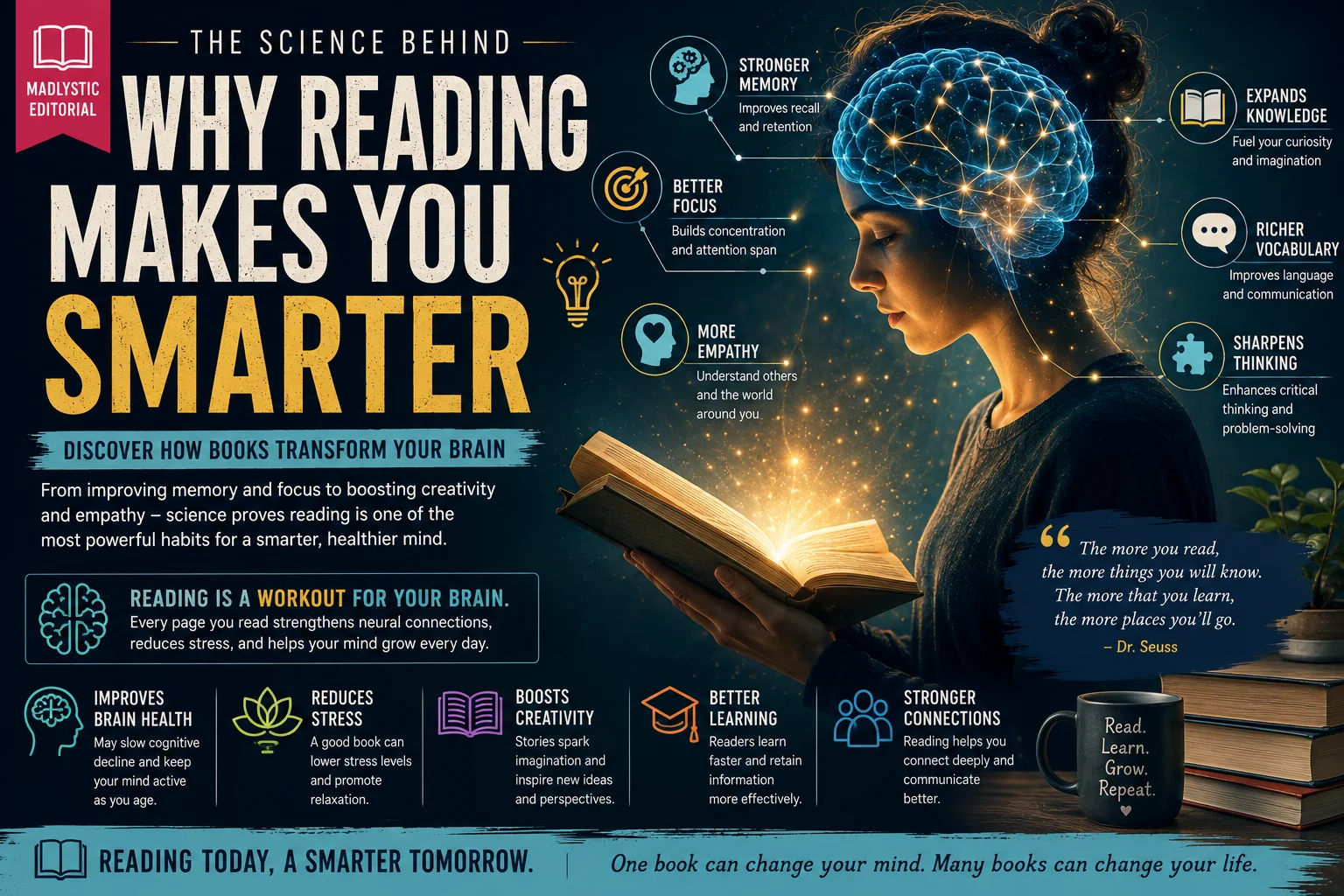
The Science Behind Why Reading Makes You Smarter
The Science Behind Why Reading Makes You Smarter | Madlystic Discover the science behind reading and learn how books improve memory, focus, creativity, vocabulary, empathy, and lifelong brain health.
Published July 7, 2026
Published by Madlystic Editorial Team | July 7, 2026
Estimated Reading Time: 14–18 Minutes
Introduction
For centuries, books have been celebrated as gateways to knowledge, imagination, and personal growth. Long before smartphones, podcasts, and artificial intelligence, people turned to books to learn about the world and themselves. Even today, despite endless digital distractions, reading remains one of the most powerful habits for improving the mind.
But does reading actually make you smarter?
The answer is more fascinating than a simple "yes."
Reading doesn't magically increase your IQ overnight, but research across neuroscience, psychology, and education consistently shows that regular reading strengthens the brain in remarkable ways. It improves memory, expands vocabulary, boosts empathy, sharpens critical thinking, reduces stress, and even helps maintain cognitive health as we age.
Whether you enjoy fantasy novels, biographies, mysteries, self-help books, or scientific journals, every page you read challenges your brain to work, adapt, and grow.
Let's explore the science behind why reading is one of the best investments you can make in your mind.
Your Brain on Books
Reading is one of the most complex activities the human brain performs.
Unlike watching television or scrolling through social media, reading requires multiple brain regions to work together simultaneously.
When you read, your brain is constantly:
Recognizing letters and words
Understanding grammar and sentence structure
Creating mental images
Predicting what comes next
Connecting ideas with previous knowledge
Processing emotions
Storing new memories
Neuroscientists often describe reading as a "full-brain workout" because so many different cognitive systems become active at the same time.
Every chapter is essentially exercise for your mind.
Reading Builds Stronger Neural Connections
Your brain contains billions of neurons connected through trillions of synapses.
Whenever you learn something new, these neural pathways become stronger.
Reading regularly encourages your brain to build new connections while reinforcing existing ones.
Think of it like exercising muscles.
The more consistently you read, the more efficiently your brain processes language, stores information, and solves problems.
This ability—known as neuroplasticity—allows the brain to adapt and continue learning throughout life.
Reading Improves Memory
Have you ever remembered an entire fictional world years after finishing a novel?
That's because reading constantly trains your memory.
As you follow a story, your brain remembers:
Character names
Relationships
Locations
Plot twists
Historical details
Magical systems
Timelines
Clues and mysteries
Every new chapter asks your brain to connect fresh information with what you've already learned.
This repeated exercise strengthens both short-term and long-term memory.
Vocabulary Growth Happens Naturally
One of the biggest advantages of reading is vocabulary expansion.
Unlike memorizing word lists, books introduce unfamiliar words naturally through context.
When readers encounter a new word multiple times:
Meaning becomes easier to understand.
Spelling becomes familiar.
Proper usage becomes intuitive.
Over months and years, these small improvements add up significantly.
People who read frequently often communicate more clearly because they have a larger vocabulary to draw from.
Reading Improves Focus
Modern life constantly competes for our attention.
Notifications, short videos, advertisements, and endless scrolling encourage our brains to switch focus every few seconds.
Reading works differently.
A book encourages sustained concentration.
Spending even 20–30 minutes reading without interruption trains your attention span and improves your ability to focus on complex tasks.
This skill benefits students, professionals, and lifelong learners alike.
Fiction Helps You Understand People
One surprising benefit of reading fiction is improved empathy.
When reading a novel, you're invited into someone else's thoughts, fears, dreams, and struggles.
You experience life from perspectives that may be completely different from your own.
Over time, this habit can improve your ability to:
Understand emotions
Recognize different viewpoints
Build stronger relationships
Communicate more effectively
Stories remind us that every person has a unique experience of the world.
Reading Strengthens Critical Thinking
Books rarely provide all the answers.
Instead, readers constantly analyze information by asking questions such as:
Is this character trustworthy?
What clues have I missed?
Why did this event happen?
What might happen next?
This process strengthens reasoning and analytical thinking.
Nonfiction books further develop these skills by encouraging readers to evaluate evidence, compare ideas, and form independent opinions.
Reading Sparks Creativity
Every novel begins with words.
Everything else exists only inside your imagination.
Unlike films, books don't show you every detail.
Instead, your brain creates:
Characters
Landscapes
Voices
Colors
Emotions
Entire worlds
This constant act of imagination strengthens creative thinking.
Many artists, entrepreneurs, designers, and inventors credit books as major sources of inspiration.
Reading Can Reduce Stress
A good book offers more than entertainment—it can also provide a break from everyday pressures.
Immersing yourself in a story often shifts your attention away from daily worries and creates a sense of mental calm.
Many readers describe books as a form of relaxation after busy days, and reading before bed has become a popular evening routine for that reason.
While everyone's experience is different, many people find that spending quiet time with a book helps them unwind and recharge.
Better Sleep Begins with Better Habits
Reading before bed is often recommended as part of a healthy nighttime routine.
Unlike bright screens that may keep your mind stimulated, a calming reading session can help signal that it's time to wind down.
Choosing a relaxing novel or nonfiction book instead of scrolling through social media may make it easier to transition into sleep.
Reading Helps Children Succeed
Children who develop reading habits early often gain benefits that extend far beyond language.
Reading regularly can support:
Vocabulary development
Listening skills
Imagination
General knowledge
Confidence in learning
Perhaps most importantly, reading together can foster curiosity and a lifelong love of learning.
Reading Across Different Genres
Different genres challenge the brain in different ways.
Mystery
Problem-solving
Pattern recognition
Logical reasoning
Fantasy
Creativity
World-building
Imagination
Science Fiction
Future thinking
Innovation
Ethical questions
Historical Fiction
Cultural understanding
Historical awareness
Biography
Inspiration
Leadership lessons
Real-world perspectives
Nonfiction
Knowledge
Practical skills
Critical thinking
A varied reading diet exercises your mind from multiple angles.
Digital Books vs Physical Books
Whether you prefer paperbacks, hardcovers, Kindle, Kobo, or another e-reader, the most important factor is that you're actively reading.
Some people enjoy the feel of printed books.
Others appreciate the convenience of carrying hundreds of books on a single device.
The best format is the one that encourages you to read consistently.
How Much Should You Read?
You don't need to finish a book every week to benefit.
Even reading 20–30 minutes a day can gradually improve your vocabulary, concentration, and knowledge.
Consistency matters far more than speed.
Small daily habits often produce remarkable long-term results.
Practical Tips to Build a Reading Habit
If you struggle to read regularly, try these strategies:
Carry a book or e-reader with you.
Replace 20 minutes of social media with reading.
Set a daily reading goal.
Join a book club or reading challenge.
Explore different genres.
Create a comfortable reading space.
Read before bedtime.
Reading becomes easier the more it becomes part of your routine.
Common Myths About Reading
Myth: Reading only fiction is a waste of time.
Reality: Fiction can build empathy, creativity, and emotional understanding.
Myth: Audiobooks don't count.
Reality: Audiobooks expose listeners to ideas and stories, though reading text and listening involve somewhat different cognitive processes.
Myth: Fast readers learn more.
Reality: Comprehension is more important than speed.
Myth: You have to finish every book.
Reality: If a book isn't working for you, it's okay to move on to one that better fits your interests.
Final Thoughts
Reading is much more than a hobby—it's a lifelong investment in your mind. Every page challenges your brain to think, imagine, remember, and grow. Over time, those small moments of daily reading can lead to stronger communication skills, deeper knowledge, greater empathy, and a richer understanding of the world.
Whether you're exploring a magical fantasy realm, solving a mystery, learning a new skill, or discovering another person's life story, you're giving your brain an opportunity to expand.
You don't need to read hundreds of books each year to experience these benefits.
Start with one chapter today.
Then another tomorrow.
Your future self will thank you.
Share this article
Share this article with readers who'll want to read it.
You may also like

Why Some Books Become Classics While Others Are Forgotten
July 15, 2026
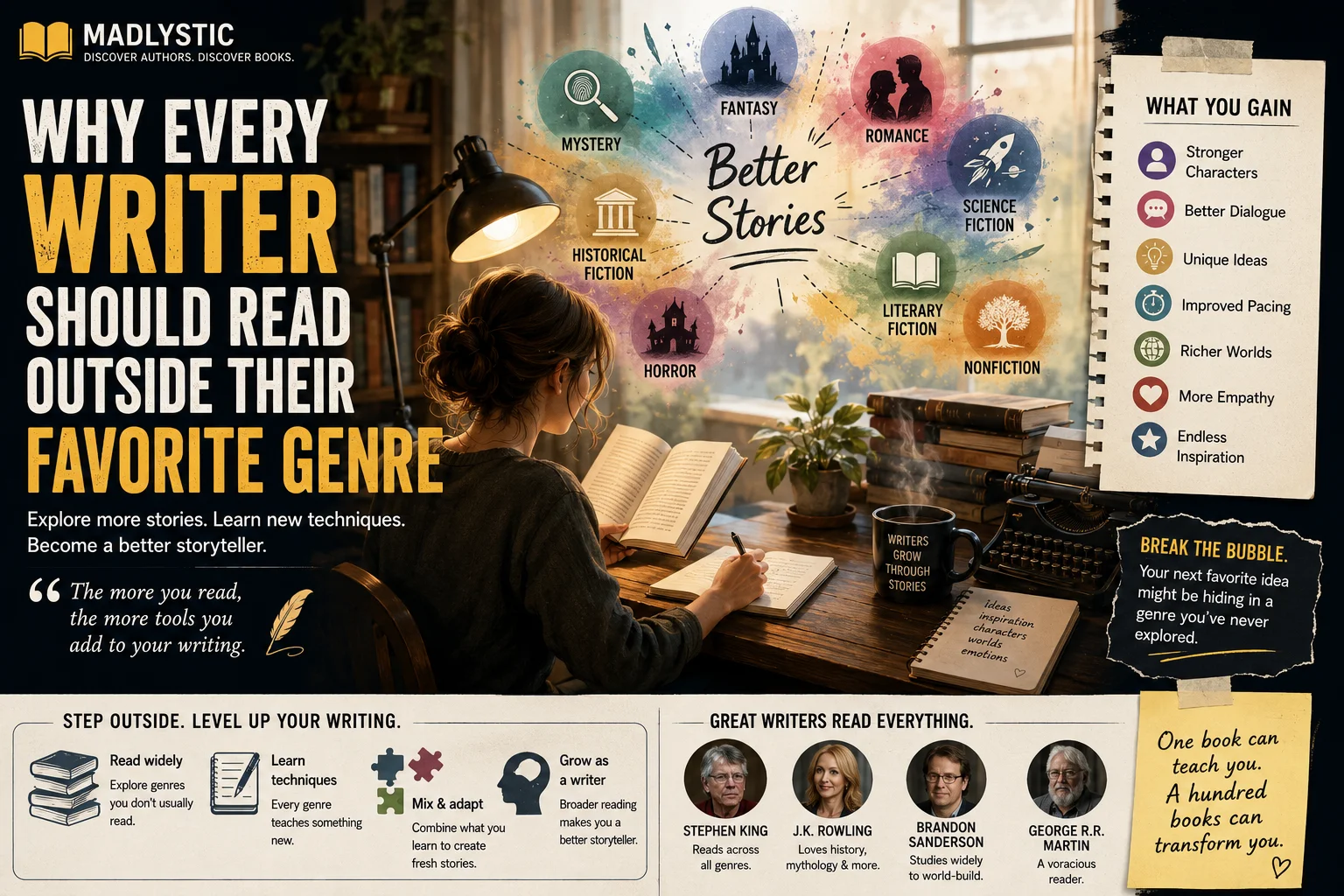
Why Every Writer Should Read Outside Their Favorite Genre
July 11, 2026
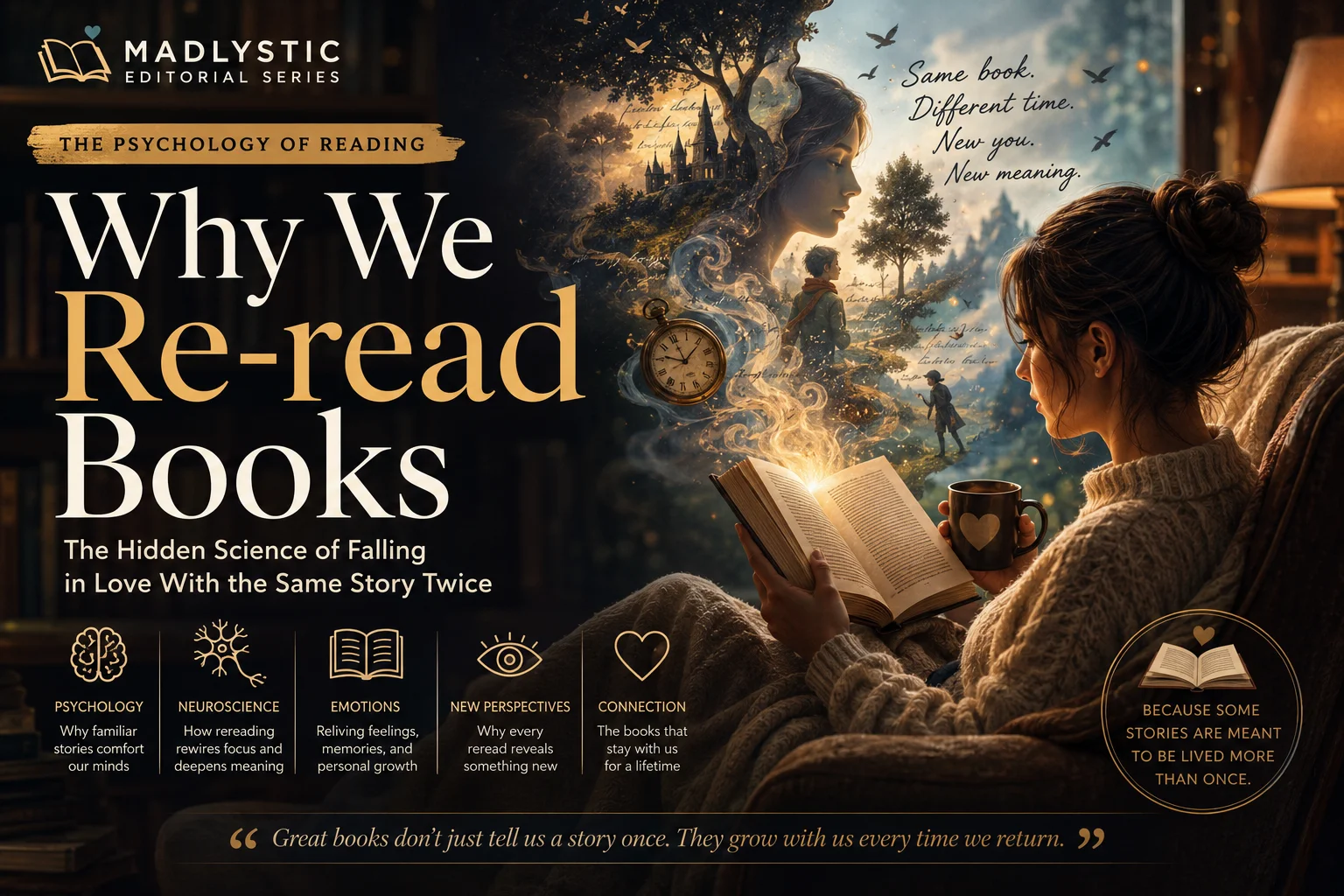
Why We Re-read Books: The Hidden Science of Falling in Love With the Same Story Twice
July 18, 2026

Why Some Books Keep You Awake All Night
July 17, 2026