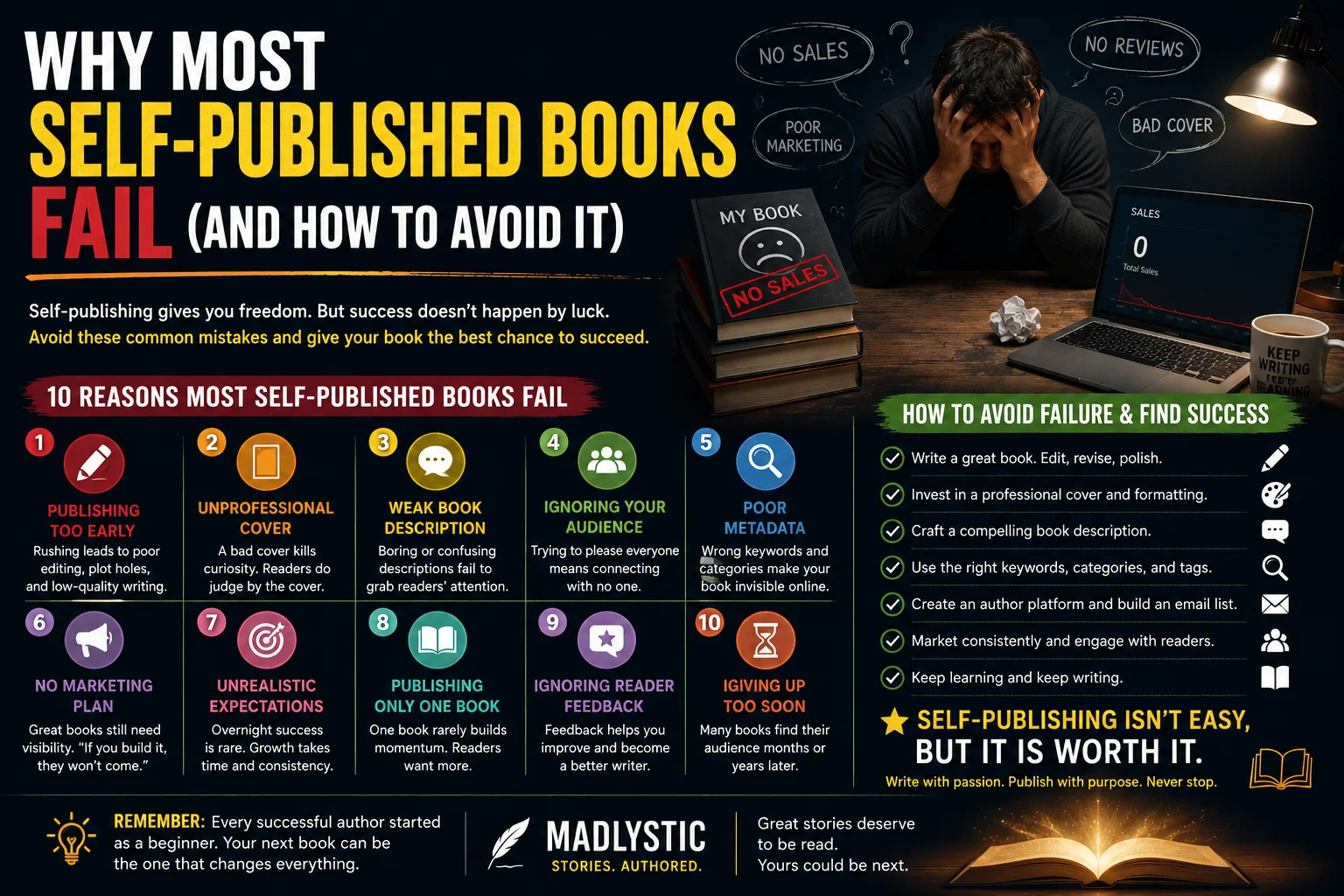
Why Most Self-Published Books Fail (And How to Avoid It)
Learn why many self-published books fail to gain readers and discover 10 practical tips to improve your writing, publishing, marketing, and long-term success.
Published July 5, 2026
Published by Madlystic Editorial Team | July 5, 2026
Every year, millions of books are self-published on platforms like Amazon Kindle Direct Publishing (KDP), Kobo Writing Life, Apple Books, and Google Play Books. For aspiring authors, self-publishing has never been more accessible.
Yet despite this incredible opportunity, the harsh reality is that most self-published books sell very few copies. Some don't even reach their first ten readers.
Does that mean self-publishing doesn't work?
Not at all.
Success in self-publishing isn't determined by luck alone—it's often shaped by preparation, quality, marketing, and persistence. Understanding why many books struggle can help you avoid the same mistakes.
Let's explore the most common reasons self-published books fail—and what you can do differently.
1. Publishing Before the Book Is Ready
One of the biggest mistakes new authors make is rushing to publish.
Excitement is understandable, but readers quickly notice:
Grammar mistakes
Plot holes
Inconsistent characters
Poor pacing
Formatting issues
Your first draft is rarely your final draft.
How to Avoid It
Revise multiple times.
Use beta readers.
Hire a professional editor if possible.
Read your manuscript aloud before publishing.
A polished book leaves a lasting impression.
2. An Unprofessional Book Cover
Readers do judge books by their covers.
A cover is often the first thing potential readers notice, and it influences whether they click to learn more.
Common mistakes include:
Cluttered designs
Hard-to-read titles
Low-quality images
Covers that don't match the book's genre
How to Avoid It
Invest in a clean, professional cover that reflects your genre and attracts your target audience.
3. Weak Book Description
Your book description acts as your sales pitch.
If it fails to capture interest, readers may never reach the first page.
Avoid:
Summarizing the entire story
Long paragraphs
Spoilers
Generic wording
Instead, focus on creating curiosity and emotional appeal.
4. Ignoring Your Target Audience
Trying to write for everyone often means connecting deeply with no one.
Ask yourself:
Who is this book for?
What do those readers enjoy?
Which genre expectations should I meet?
Knowing your audience helps shape your writing, cover, keywords, and marketing.
5. Poor Metadata
Many new authors underestimate metadata.
Your title, subtitle, keywords, categories, and description all help readers discover your book.
Poor metadata can make even a great book difficult to find.
Tips
Choose relevant keywords.
Select accurate categories.
Research competing books in your genre.
Think of metadata as your book's digital address.
6. No Marketing Plan
Publishing is not the finish line—it's the starting point.
Many authors upload their book and wait for sales that never come.
Readers can't buy a book they don't know exists.
Build a Marketing Strategy
Create an author website.
Share updates on social media.
Join reader communities.
Build an email newsletter.
Encourage honest reviews.
Network with other authors.
Consistent promotion matters more than one big launch day.
7. Unrealistic Expectations
Some authors expect instant success after publishing.
In reality, building an audience takes time.
Most successful independent authors publish multiple books before gaining steady readership.
Focus on long-term growth rather than overnight success.
8. Publishing Only One Book
Readers who enjoy your work often want another book immediately.
If you only have one title available, it's harder to build momentum.
Writing consistently helps:
Grow your catalog.
Increase visibility.
Build reader loyalty.
Each new release can also introduce readers to your earlier books.
9. Ignoring Reader Feedback
Not every review will be positive—but thoughtful feedback can help you improve.
Pay attention to recurring comments about:
Pacing
Characters
Dialogue
Editing
Formatting
Learning from readers is part of becoming a stronger writer.
10. Giving Up Too Soon
Perhaps the biggest reason some books fail is that their authors stop trying.
Many books don't find an audience immediately.
Some gain momentum months—or even years—after publication through reviews, recommendations, or a growing backlist.
Persistence is one of the most valuable qualities an author can have.
Success Is a Marathon, Not a Sprint
Self-publishing offers something that traditional publishing often cannot: complete creative control.
But with that freedom comes responsibility.
Successful authors continue learning about:
Writing
Editing
Cover design
SEO
Marketing
Reader engagement
Every book teaches valuable lessons for the next one.
Practical Checklist Before You Publish
✔ Professionally edited manuscript
✔ Eye-catching cover
✔ Strong book description
✔ Correct categories and keywords
✔ Proper formatting
✔ Author website or social media presence
✔ Marketing plan
✔ Beta reader feedback
✔ Proofread final version
✔ Long-term publishing mindset
Final Thoughts
The majority of self-published books don't fail because their authors lack talent—they often struggle because they reach readers before they're fully prepared, or because they aren't effectively marketed after publication.
Every successful independent author started somewhere. The difference is that they kept improving with each book, listened to their audience, refined their craft, and stayed committed even when results were slow.
Self-publishing isn't a shortcut to success—it's an opportunity to build a writing career on your own terms.
Write with passion. Publish with patience. Market with purpose.
And above all, keep writing.
The next book you publish might be the one that changes everything.
Share this article
Share this article with readers who'll want to read it.