The 4 Types of Book Editing (And Which Ones You Actually Need)
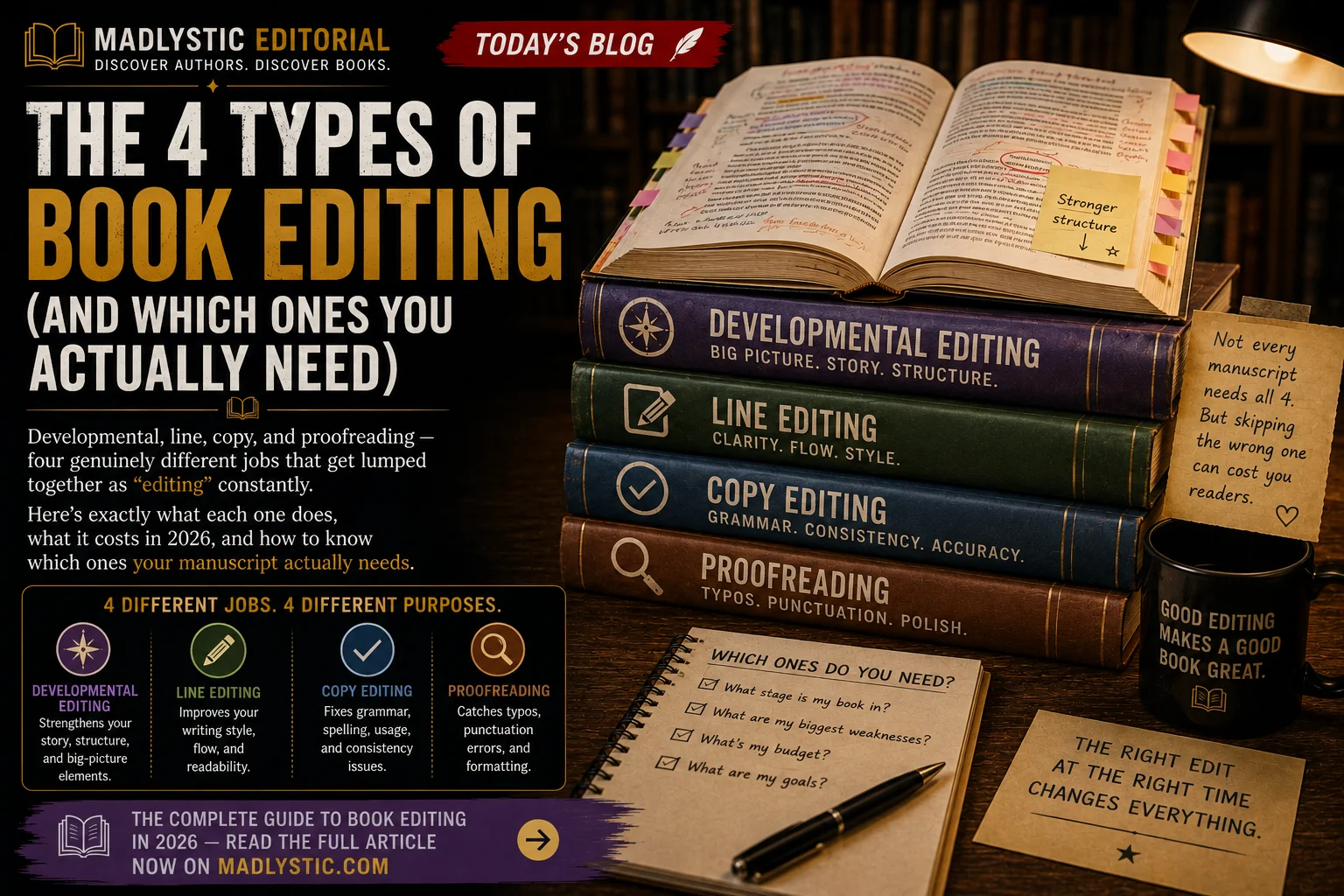
Developmental, line, copy, and proofreading — four genuinely different jobs that get lumped together as "editing" constantly. Here's exactly what each one does, what it costs in 2026, and how to know which ones your manuscript actually needs.
Published August 4, 2026
9 min read
Quote of the Day
"Developmental editing is about making fundamental improvements to the relationship among the author, the reader, and the meaning of the book. That's a lot more than just figuring out where textual errors are or tweaking awkward sentences." — Josh Bernoff, editorial consultant
Ask ten new authors what "getting your book edited" means, and you'll get ten different answers — because "editing" isn't actually one job. It's four genuinely distinct disciplines, each catching a different category of problem, each requiring different skills, and each costing meaningfully different amounts. Confusing them is one of the most common, most expensive mistakes a first-time author makes — paying for a copy edit when the manuscript actually needed a developmental one first, or the reverse.
Developmental editing: the big-picture pass, done first
This is the broadest, most structurally significant edit, and it happens before anything else, always. A developmental editor isn't looking at individual sentences at all — they're evaluating plot logic, pacing, character arcs, structural weaknesses, and whether the book actually accomplishes what it's trying to do. Editorial consultant Josh Bernoff draws a useful distinction here: this isn't about finding textual errors or tweaking awkward phrasing, it's about fixing the fundamental relationship between the author, the reader, and the book's actual meaning — which sometimes means recommending an author cut entire chapters, restructure the timeline, or rewrite a character's motivation from the ground up.
It's also, unsurprisingly, the most expensive tier: the EFA's 2026 rate chart puts fiction developmental editing at roughly $0.03-$0.035 per word, and Bernoff notes that genuinely thorough developmental work on a modest 50,000-word manuscript can run past $10,000 with an experienced editor — pricing that reflects both the specialized skill involved and the fact that developmental editing isn't a linear read-through; an editor often has to jump back and forth across the whole manuscript, tracking patterns that only become visible once they've seen the full story.
Line editing: the sentence-by-sentence craft pass
Once the big structural issues are resolved — there's no point polishing prose in a chapter that's about to get cut — a line edit zooms all the way in, working sentence by sentence to strengthen voice, tighten awkward phrasing, improve rhythm and pacing at the prose level, and make sure the writing actually sounds like the author at their best. One editor described it well: a thorough line edit will typically catch most copy-editing issues along the way too, simply because you can't read that closely without noticing grammar problems in passing — but voice and flow are the actual focus, not error-catching.
Line editing runs slightly more than copy editing — the EFA's 2026 figures put it around $0.027-$0.036 per word for fiction, roughly 10-20% above copy editing rates — reflecting the more subjective, craft-level judgment required.
Copy editing: the technical correctness pass
This is the more mechanical of the two prose-level edits: grammar, spelling, punctuation, and consistency — making sure character names, timelines, and details stay accurate throughout, that tense and point of view don't drift, and that the manuscript conforms to standard publishing conventions. A copy editor generally isn't making creative judgment calls about voice or pacing; they're finding and fixing objective errors. 2026 EFA rates land around $0.02-$0.027 per word for fiction, meaningfully cheaper than either developmental or line editing.
Proofreading: the final, lightest pass
This is the last stop, done only after every other edit is complete, ideally on the actual publication-ready file — a formatted PDF or EPUB, not a working manuscript draft. A proofreader isn't evaluating structure, voice, or even grammar in a deep sense; they're catching the small things that survive every previous pass: a stray typo, an inconsistent formatting choice, a leftover double space. It's deliberately the lightest-touch, least expensive tier, running $0.012-$0.02 per word according to 2026 EFA figures.
Traditional Sale vs. Kindle Unlimited — no, wrong reflex, here's the actual comparison for this piece:

Why the order actually matters, not just the definitions
One detail worth taking seriously: these four stages aren't interchangeable, and doing them out of order genuinely wastes money. There's no benefit to copy-editing a chapter you're about to cut in developmental revisions, and combining developmental editing with copy editing in a single pass is generally considered a mistake, since the two require fundamentally different mindsets — one is creative and structural, the other is mechanical and detail-oriented, and trying to do both simultaneously tends to shortchange one or the other. Line editing and copy editing can sometimes reasonably be combined by an editor who explicitly scopes it that way, but developmental work always has to happen first, on its own, before anything else makes sense to pay for.
Do you actually need all four?
Not necessarily, and this is where most existing guides oversimplify. A debut novel in commercial fiction genuinely benefits from all four stages — skipping one tends to show up in reader reviews eventually, in ways an author can't always see in their own work. An experienced author on their fifth or sixth book has often internalized a lot of what line editing catches, and can sometimes reasonably skip straight to developmental, copy editing, and proofreading. Nonfiction typically follows a similar pattern to fiction, though line editing is more frequently rolled into the copy edit for how-to or business books, where voice matters less than clarity. Short-form work — novellas, short stories, blog-style books — can often get away with copy editing and proofreading alone, skipping the heavier developmental and line stages entirely if the structure is already sound.
One practical safeguard worth knowing about
Before committing to any full edit, request a sample edit — typically 1,000-2,000 words of your actual manuscript, edited the way the editor would approach the whole thing, usually free or for a small fee. An editor who refuses to provide one is a legitimate red flag. This single step costs a few hours and, worst case, a modest fee — and it's specifically designed to catch a mismatch in style or approach before you've committed thousands of dollars to a full manuscript edit.
Conclusion
"I need my book edited" is really four different requests hiding inside one phrase, and knowing which one you actually need — and in what order — is the difference between spending money efficiently and paying twice for work that should have happened once, in the right sequence. Developmental editing asks whether the story works. Line editing asks whether the prose sings. Copy editing asks whether it's technically correct. Proofreading asks whether anything slipped through. Skip the wrong one, or do them out of order, and it tends to show up exactly where you don't want it to: in a reader's review, after the book is already out in the world.
Share this article
Share this with readers who'll want to know.
You may also like
Traditional Publishing vs. Self-Publishing: Which Is Right for You?
November 24, 2026
How to Choose Amazon KDP Keywords and Categories
November 20, 2026
How Long Should a Book Be? Word Count by Genre (2027)
November 16, 2026
How to Self-Publish a Book on Amazon KDP (2027 Guide)
November 15, 2026